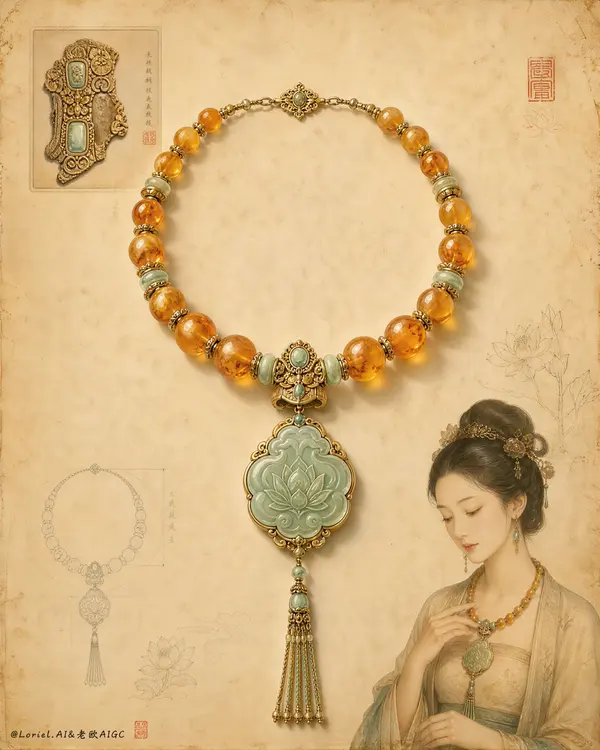
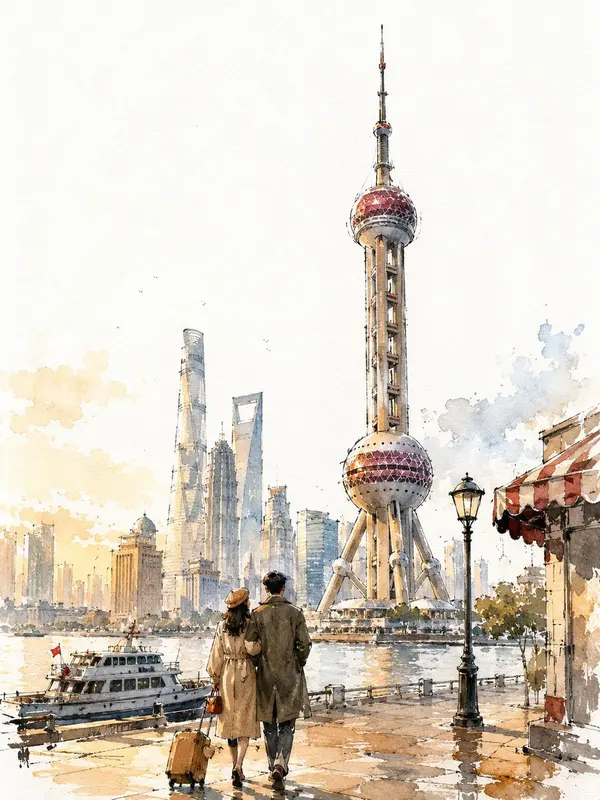
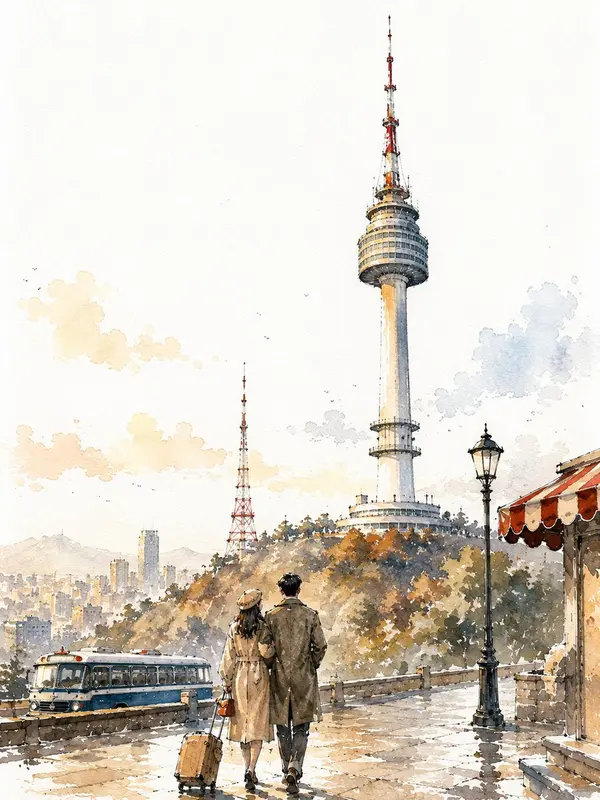
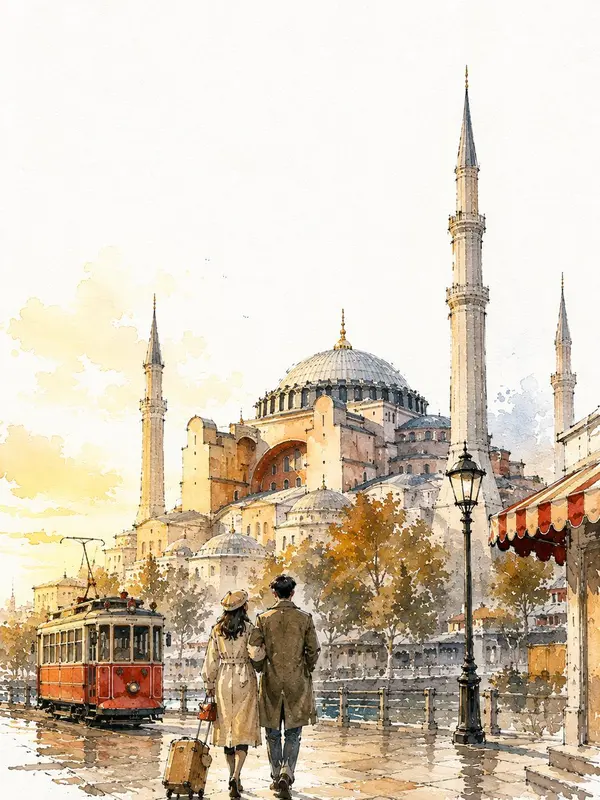
ChatGPT Images 2.0 is OpenAI's image generation model for creating production-ready visuals from prompts, including posters, ads, infographics, comics, layouts, and multilingual text-heavy designs.
How are the prompts collected?
The gallery is hand-picked by our team from creators sharing their work in public communities. If a prompt of yours is featured and you'd prefer it taken down, just reach out and we'll remove it right away.
How do I try a prompt?
Hit the Try button on any card and you'll be taken straight to Playyy with the prompt pre-filled — generate the image with one click, no copy-pasting needed.
Can I submit my own prompts?
Submissions are coming soon. In the meantime, share standout prompts with us on X or Discord and we'll review them for inclusion.
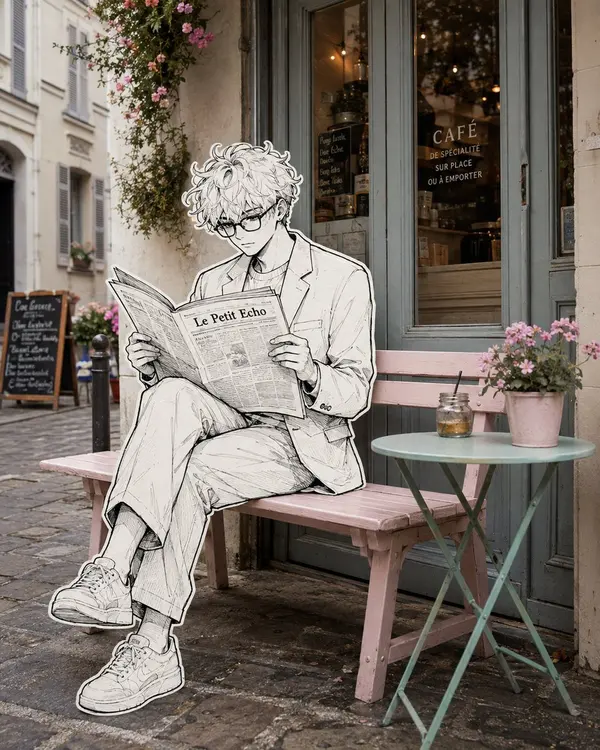
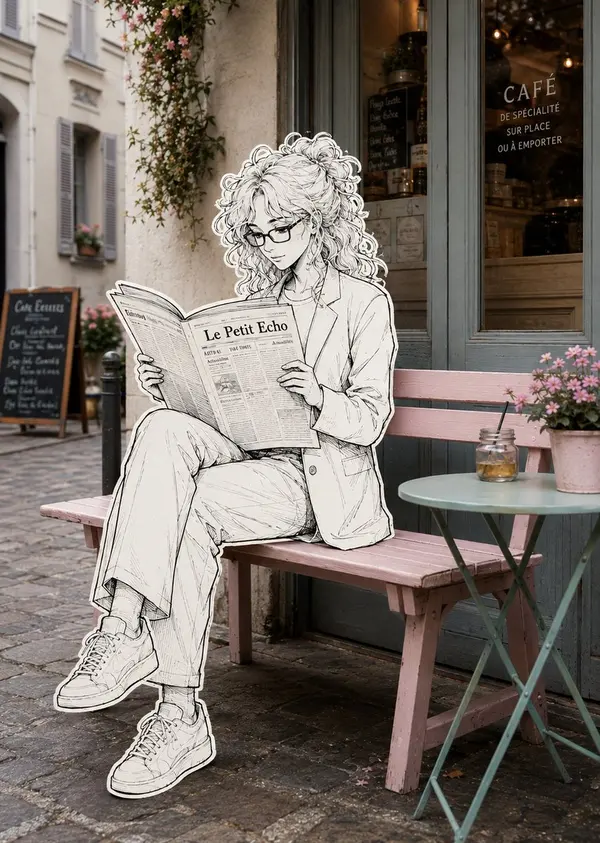
Create a surreal editorial street photograph that seamlessly blends a real-life Parisian café exterior with a hand-drawn black-and-white illustrated character. A stylish young woman with long wavy hair, rectangular glasses, a tailored light blazer and wide-leg trousers sits naturally on a pastel pink wooden bench outside a charming French café, legs crossed, calmly reading a large newspaper. Render the entire woman, her clothing, shoes, hands and newspaper as a detailed monochrome ink illustration with expressive fine linework, delicate cross-hatching, subtle sketch texture and a clean thick white sticker-like outline around her entire silhouette. Keep the café environment completely photorealistic and softly colored: weathered French architecture, muted blue-gray café doors and windows, warm interior lights, cobblestone pavement, climbing flowers, a small mint-green round café table, pink flower pot and glass jar. The illustrated character must physically interact with the real bench and environment with accurate perspective, scale, contact shadows and natural placement. Elegant whimsical mixed-media photography, 2D hand-drawn illustration merged into reality, sophisticated European street aesthetic, subtle film grain, soft natural daylight, realistic depth of field, highly detailed, cinematic composition, photorealistic background, vertical 4:5.
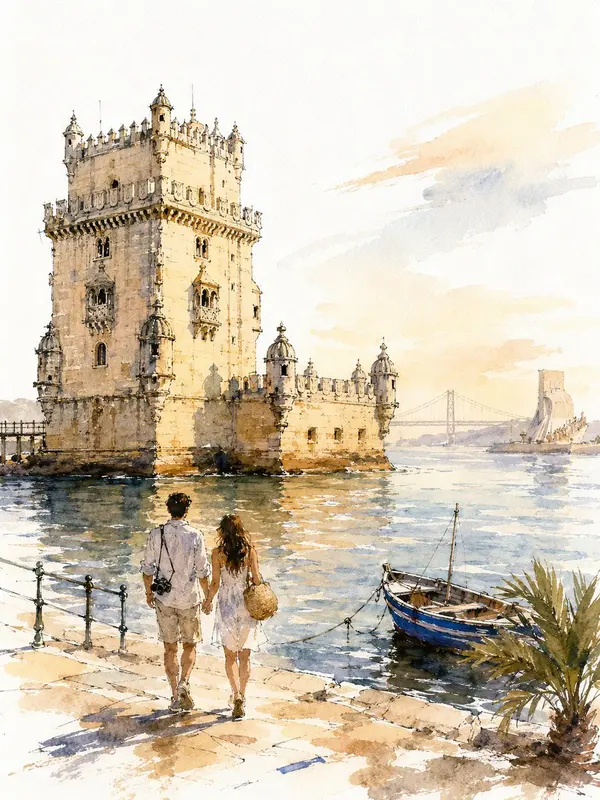
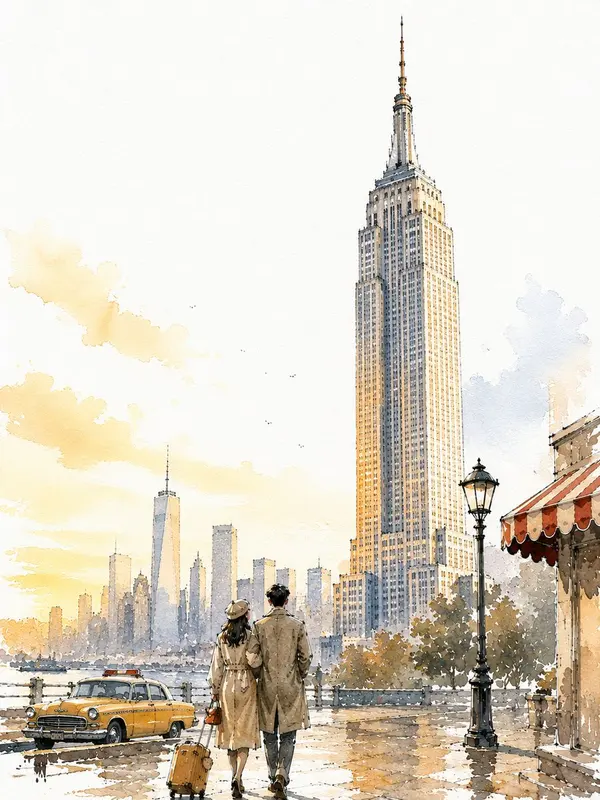
A loose, unfinished watercolor-and-ink travel sketch of New York: fast broken
line, uneven washes, generous bare paper, golden-hour light.
SUBJECT
Hero: the Empire State Building from street level, frontal and slightly
upward-tilted, full height inside the frame, 68–75% of poster height, anchored
on the right third, base in the lower-middle third.
Behind it: the Chrysler crown, small and low left, plus 2–3 soft masses standing
in for Midtown. Nothing else — no Liberty, no Brooklyn Bridge, no Times Square.
Bright white cold-press paper, no cream or sepia cast.
IDENTITY LOCK — the only sustained drawing in the image
(a) stepped Art Deco setbacks narrowing in stages toward the top
(b) continuous vertical piers with recessed window bands — long strokes, never
individual windows
(c) the tiered crown lantern with mooring mast and antenna
These carry the strongest contrast, are never cropped, never fade to blank paper.
COUPLE
A young couple seen from behind, arms linked, walking up the avenue, one
glancing up at the tower. 14–18% of poster height, in the bottom 22–25% band.
Mid-century-cut travel coats; a small handbag, a compact suitcase.
10–15 strokes each — silhouette, hair mass, coat line, legs. No faces, no
fingers, no folds, no third figure. The most resolved human element in the image.
LINE
Contours break, skip, overshoot corners, and stop before meeting; weight varies
within a single edge. Background architecture is gestural only — a roofline, a
corner, an implied vertical. If a building reads in 5–8 strokes, stop at 8.
Never window-by-window, never brick. Some forms exist as wash alone, no line.
WATERCOLOR
Never fill evenly. Within one surface the wash swings from deep pooled pigment
on one side to bare paper on the other. Blooms and backruns with cauliflower
edges, wet-in-wet bleed, hard pooled edges beside dissolved ones, dry-brush
skips, granulation in the grain. Washes overshoot the ink by 5–10% in places and
fall short elsewhere. No object is uniformly colored.
Coverage 55–65%: leave bare paper across most of the sky, the distant city,
sunlit faces, the outer 10–15% of the frame, and gaps in the pavement. Bare
shapes are brush-formed and irregular, never rectangular.
VALUE
6–10 fingernail-sized darks in burnt umber or dark indigo — setback shadows,
window bands, under the awning, beneath the taxi and the couple, tower base.
Drop them into damp wash so they bloom. Without these the image is a flat
pastel smear.
DEPTH
Foreground strongest pigment and clearest line; distance at 15–25% pigment in
dusty blue-gray and hazy peach with almost no line, grouped into 2–3 masses.
LIGHT & COLOR
Golden hour, light raking from the left so the tower has a lit face and a shaded
face. Sky: 3–5 broad strokes, the rest bare paper, no detailed clouds.
Warm limestone cream, pale apricot, warm gray, dusty steel blue, soft graphite.
One saturated accent: taxi yellow. Props, 3 only — a yellow cab from behind, a
lamp post, a striped awning edge.
TEXT
None anywhere: no title, caption, signage, storefront name, street sign, number,
logo, or pseudo-lettering. Signs become abstract shapes. The top 15–18% stays
clean and empty for titling added later.
AVOID
Photorealism, CGI, 3D render, generic AI architecture, hybrid or duplicated
towers, extra setbacks, warped façade, repeating-window artifacts, mechanically
even line weight, floating objects, roads into walls, inconsistent scale,
visible faces, extra figures, flat even fills, uniform contrast at all
distances, edge-to-edge painting, neon color, garbled text.
Bare paper beats invented detail — everywhere except the identity features.
RECOGNITION FIRST, VALUE SECOND, ATMOSPHERE THIRD, DETAIL LAST.
Location: "[LOCATION]"
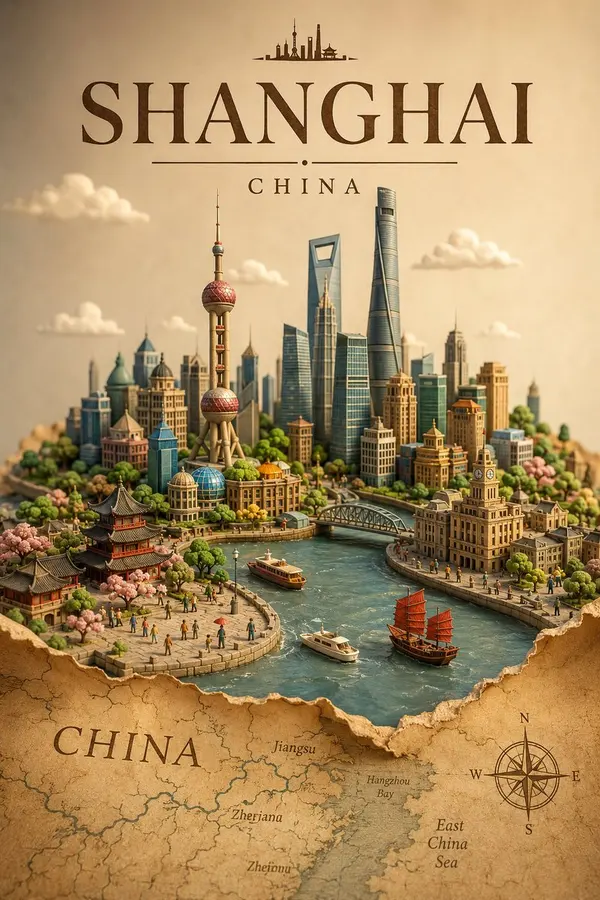
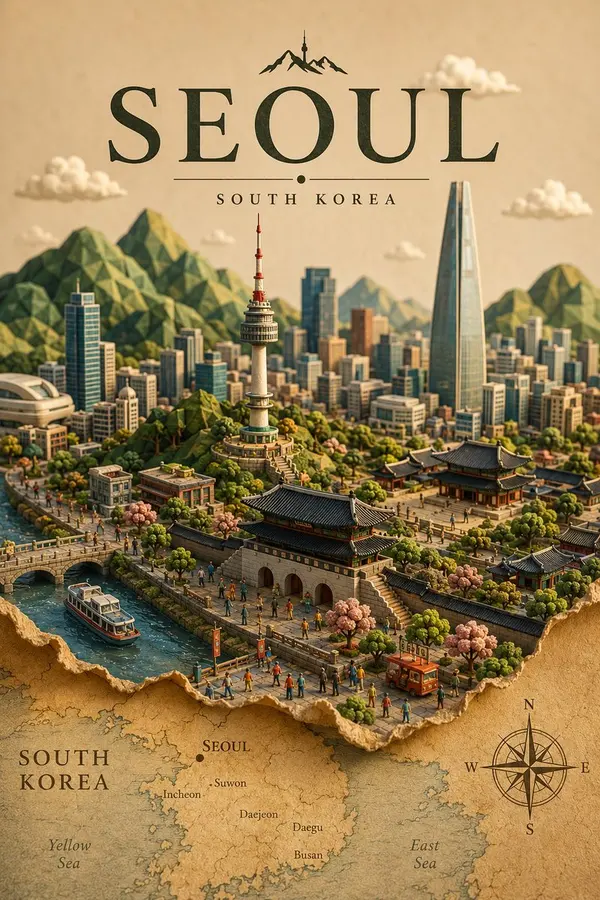
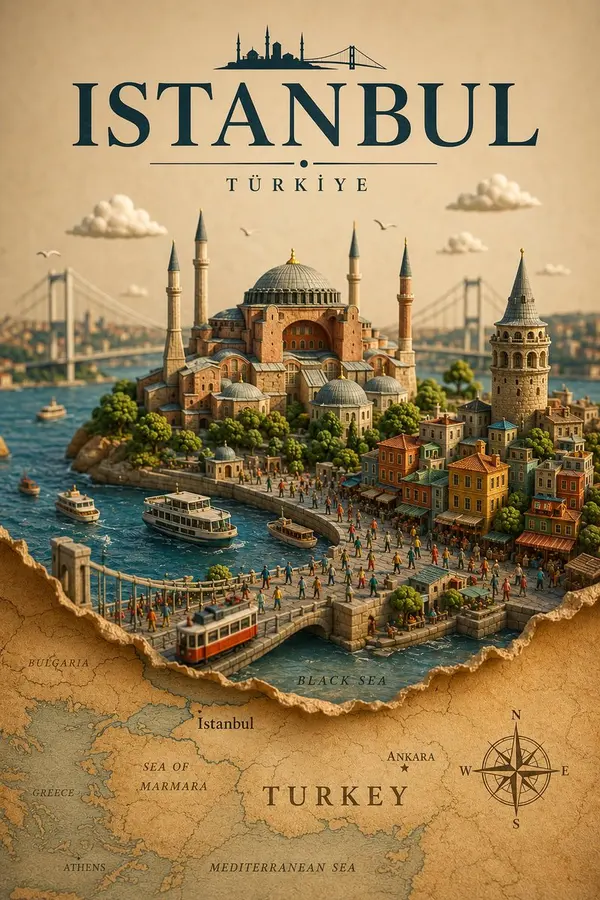
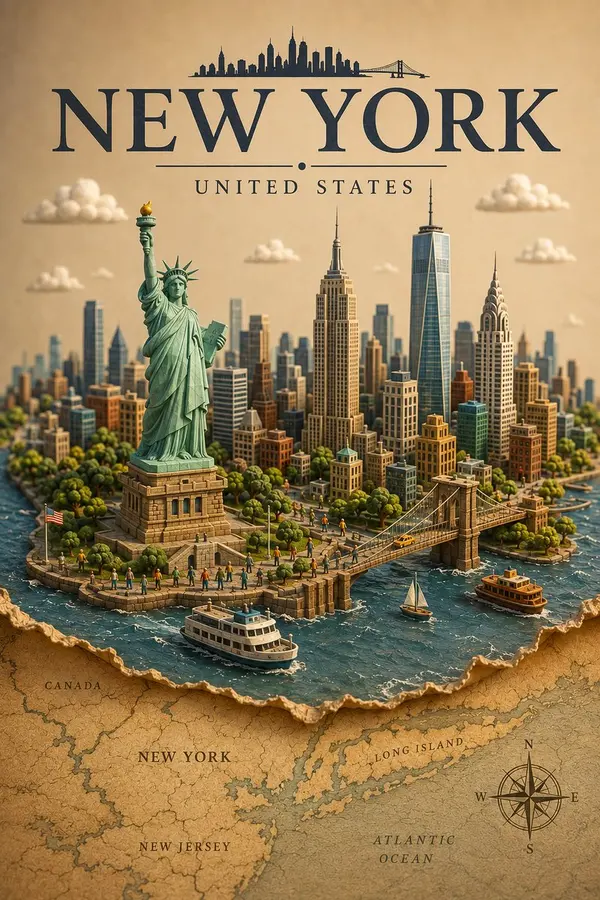
Create a premium vertical travel-poster illustration of [LOCATION] in a distinctive mixed-media low-poly 3D + handcrafted plasticine/clay diorama style.
Main Scene
Transform [LOCATION] into a highly detailed miniature world emerging from a torn antique geographical map. Make the destination instantly recognizable and geographically accurate.
Include the most iconic features of [LOCATION], such as:
Primary landmark or natural attraction
Characteristic mountains, cliffs, valleys, forests, rivers, waterfalls, coastline, architecture, or terrain
Local vegetation and environmental details
Scale-appropriate visitors, hikers, boats, animals, or vehicles
Authentic local architectural elements where relevant
Visual Style
Combine low-poly 3D geometry for terrain, mountains, rocks, cliffs, buildings, and structures with hand-sculpted plasticine/clay for vegetation, clouds, people, animals, flowers, and smaller details.
Show subtle fingerprints, rounded clay forms, handcrafted imperfections, polygonal facets, realistic physical materials, cinematic depth, atmospheric perspective, and the premium feel of a collectible stop-motion miniature diorama.
Poster Composition
Use a clean, elegant travel-poster layout:
[LOCATION]
"[REGION / COUNTRY]"
Place the title prominently at the top in sophisticated serif typography, with a small minimalist mountain or destination icon above it and a thin decorative line below.
Keep the miniature landscape as the main visual focus across the center and lower portion.
At the bottom, integrate a torn piece of antique map paper featuring:
Country name
Nearby geographic locations
Relevant seas, oceans, rivers, mountains, or regions
Small compass rose
Subtle authentic cartographic markings
The torn map should naturally curl upward around the miniature landscape, creating the illusion that [LOCATION] is physically emerging from the map.
Color & Lighting
Use a sophisticated natural palette appropriate to [LOCATION], with rich greens, earthy stone tones, natural water colors, atmospheric blues, and warm parchment.
Use soft cinematic golden-hour lighting, gentle shadows, realistic ambient occlusion, subtle volumetric atmosphere, and warm highlights across the miniature surfaces.
Important Requirements
Keep the landmark recognizable, geographically believable, and specific to [LOCATION]. Avoid generic scenery, excessive fantasy, incorrect geography, random architecture, or unrelated tourist attractions.
Maintain a clean, premium editorial composition with clearly readable typography and the landscape as the dominant visual focus.
Aspect Ratio: 2:3 vertical
Style: Premium handcrafted travel poster, low-poly 3D, plasticine clay miniature, cinematic diorama, highly detailed, photorealistic miniature photography, elegant editorial design.
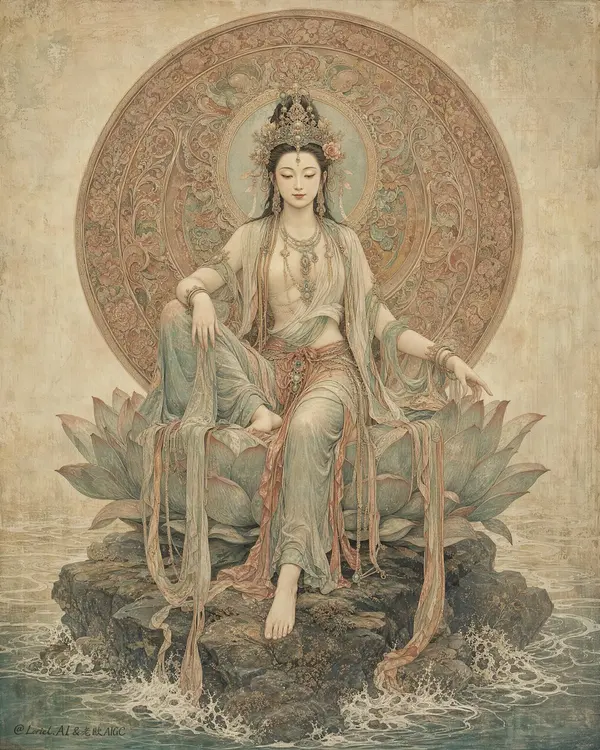
Create an ultra-premium East Asian sacred art poster that merges Orbit-style symbolic monumentality with Transit-style museum-grade elegance, while adding an appropriate faded watercolor-like antique patina across the entire image. Show one serene celestial goddess seated front-facing on a large layered lotus throne rising from dark weathered rocks above shallow swirling water, centered in a tall vertical frame. Behind her head, place one large circular ornamental halo-disc filled with intricate floral and sacred relief patterns, perfectly framing her upper body like a ceremonial mandala. The final artwork must feel sacred, elegant, antique, softly aged, painterly, and collectible, like a rare devotional mural-painting artifact. No title, no logo, no readable text, no real person identity.
Core composition:
Use a strict centered vertical composition with the goddess occupying the full central axis from halo to lotus base. Her seated body must feel calm, monumental, and balanced. One leg lowers naturally toward the rock base while the other rests higher in a graceful asymmetrical pose. The lotus throne and rock base must anchor the composition with strong sacred weight. The circular halo-disc behind her should be large, full, and nearly iconic in scale, creating a powerful devotional silhouette.
Orbit enhancement:
Increase the monumentality of the sacred icon structure. The halo-disc should feel larger and more complete behind the figure, almost pressing the full spiritual force of the image forward. The lotus throne and rock base should feel more substantial and sculptural, giving the figure stronger divine presence. The whole composition should read immediately as a powerful three-part symbol: centered goddess, circular halo, lotus-rock throne.
Transit enhancement:
Refine the image into a more international museum-art language. The palette should feel quieter, more mineral, more elegant, and more globally collectible. Reduce any overly warm or decorative saturation. Keep the lighting restrained, the materials sophisticated, and the overall impression like a high-end exhibition poster for an ancient sacred masterpiece.
Aged light-color patina:
This is the key addition. Apply an appropriate light faded antique wash across the entire image, as if the artwork has lived on silk, fresco plaster, or mineral paper for centuries. The patina should be subtle and beautiful: soft desaturation, slight powdery pigment bloom, gentle worn edges, faint watercolor-like tonal diffusion, and delicate aged surface calm. It must not look dirty or damaged. The result should feel like elegant time-softened color, not decay.
Figure design:
Design an original adult divine feminine figure inspired by classical East Asian sacred sculpture and devotional painting. She must feel compassionate, serene, and spiritually elevated. Her face should be delicate and calm, with lowered eyes, soft brows, subtle lips, and a peaceful meditative expression. Her anatomy must be elegant and natural, with correct shoulders, arms, hands, torso, and posture. She wears layered flowing robes with long trailing sashes and softly revealed upper chest in a sacred historical-art way, always dignified and ceremonial.
Costume and ornament:
Dress her in layered mineral-toned robes of celadon gray-green, faded terracotta, dusty coral, pale parchment, and aged ivory. Add refined antique jewelry, pendant chains, earrings, and a balanced floral-jewel headpiece. The fabrics and ornaments must feel softened by time, as if painted with diluted pigments over an aged surface.
Halo-disc design:
Render the halo as a richly ornamented circular disc with dense floral and sacred scroll relief in muted reddish-brown, aged copper, faded russet, and antique mineral tones. It should feel historical, intricately crafted, and devotional, with slightly softened edges from age.
Lotus and base:
Render the lotus throne as layered and sculptural with desaturated blue-green, gray-teal, and stone-lotus tones. The rock base beneath should feel dark, mineral, and weathered. Add shallow sacred water with gentle pale foam and flowing pattern logic. Everything below the figure must support stillness and icon gravity.
Lighting:
Use soft diffused sacred lighting from upper front-left with very gentle frontal fill. The figure, halo, lotus, and drapery should glow softly through muted tonal transitions. No harsh drama. The light must feel calm, spiritual, and respectful to the antique surface quality.
Material rendering:
Render skin like painted sacred sculpture with matte softness and delicate age integration. Render robes as faded silk-like mineral pigment drapery. Render jewelry with restrained antique-metal detail. Render halo and lotus with painted-relief texture and worn ceremonial richness. Render the full surface with subtle fresco grain, paper tooth, faint crackle, and collector-grade patina.
Background:
Keep the background pale, atmospheric, and minimal, built from parchment beige, faded mineral wash, cloudy plaster texture, and faint devotional atmosphere. No clutter, no crowded architecture, no unrelated objects.
Color system:
Use a restrained sacred palette of celadon gray-green, dusty terracotta, faded coral, aged ivory, parchment beige, muted russet, stone gray, desaturated blue-green, and dark mineral accents. The entire image should feel softened by time and unified by elegant antique color restraint.
Image finish:
The final artwork must feel like a world-class sacred art poster: serene, monumental, collectible, and gently time-worn. Preserve strong detail in the face, crown, halo ornament, robe folds, lotus petals, and rock textures, while bathing the whole piece in a refined aged light-color patina. 8k, museum-grade sacred visual quality.
Negative prompt:
readable text, logo, neon colors, glossy fantasy styling, modern fashion, vulgar exposure, cartoon face, broken hands, extra fingers, missing fingers, distorted anatomy, plastic skin, cluttered background, cheap gold effects, dirty decay, heavy stains, muddy shadows, black blotches, low-detail halo, low-resolution texture
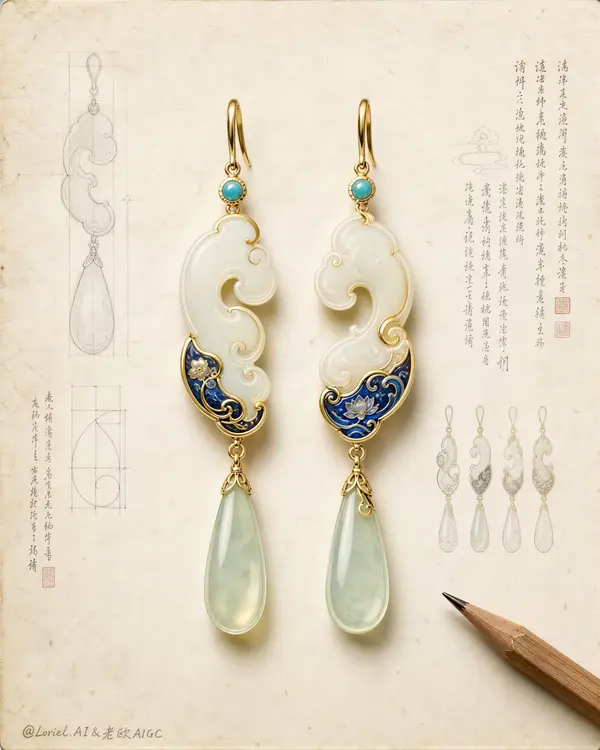
Create an ultra-premium jewelry archive poster that merges a world-class luxury brand design sheet with an East Asian heritage artifact study board. Keep the original structural logic but refine it toward a more international flagship presentation: one pair of exquisite hanging earrings placed at the visual center on a spacious warm-white aged paper ground, surrounded by only a small number of highly disciplined technical sketches, miniature variant studies, elegant manuscript note columns, and one sharpened wooden pencil entering from the lower right corner. The composition must feel calm, expensive, intelligent, and collectible, like a museum-grade design archive reinterpreted as a luxury campaign visual.
Design a new pair of statement earrings inspired by traditional jade, archaic cloud-scroll language, and refined enamel ornament, without copying any existing shape. Each earring should feature a slim polished gold hook, a tiny turquoise connector stone, an elongated white-jade main body with graceful asymmetrical cloud curvature, a compact lower section enriched with deep cobalt-blue enamel floral or wave motifs, delicate gold contour filigree, and one long pale celadon translucent teardrop pendant suspended below. The pair should feel handcrafted and subtly varied, not mechanically mirrored, while still reading as a coherent luxury set. Make the earrings occupy roughly 60 percent of the visual attention and remain the absolute hero.
Push the Transit direction strongly: the page should be cleaner, more spacious, and more elevated, with more controlled negative space, more disciplined object placement, fewer sketch fragments, and a stronger sense of premium restraint. The jewelry should look like it belongs to an international high-jewelry maison presenting a heritage capsule collection. Push the Port direction strongly: compress the image memory into three dominant symbols only, the central earring pair, the surrounding pale technical sketch aura, and the lower-right pencil. Remove unnecessary tiny distractions so the visual identity becomes sharper and more iconic.
Lighting should be soft, refined, and highly controlled from the upper left, creating elegant shallow shadows on the paper, restrained luminous reflections on gold edges, subtle glow through semi-translucent jade, and delicate enamel sheen. Contrast should be gentle but precise, with enough dimensionality to make the jewelry feel tactile and precious while preserving the calm archival atmosphere. The paper background must be matte ivory-white with slight aging, faint fibers, tiny foxing marks, erased graphite residue, and subtle workshop traces, but remain pristine, rarefied, and premium.
Supporting elements must be sparse and intentional: faint graphite contour studies, one or two orthographic geometry diagrams, a few miniature alternate earring thumbnails, one or two proportion grids, and several short vertical columns of newly invented decorative manuscript text with tiny seal-like red accents. These note elements must feel like antique jewelry research annotations, not modern readable branding, and they should remain light and secondary. No copied text, no dominant typography, no loud layout blocks.
Material rendering must be extremely refined: creamy nephrite-like white jade with soft inner translucency, pale celadon pendants with smooth light transmission, polished gold with warm restrained reflections, cobalt enamel with slight depth and handcrafted surface precision, tiny gemstone bezels, elegant hook curvature, and believable jewelry engineering. The pencil should be natural cedar wood with a sharp graphite tip, rendered realistically but kept subordinate.
Style: luxury jewelry campaign, museum archive sheet, heritage object study board, premium product photography fused with technical drawing aesthetics. Color palette: warm ivory paper, white jade, pale celadon, turquoise, cobalt blue, muted antique gold, graphite gray, tiny cinnabar-red seal accents. The overall mood should be noble, scholarly, modernized, and globally premium.
No clutter, no extra jewelry piles, no excessive diagrams, no cheap craft feeling, no plastic texture, no oversaturated color, no loud branding, no modern graphic blocks, no messy stains, no dark dirty patches, no distorted metal hooks, no malformed symmetry, no chaotic text, no watermark, no logo.
VINTAGE CITY TRAVEL POSTER - [CITY, COUNTRY] (3:4)
A loose, hand-painted watercolor-and-ink travel sketch of [CITY], with fast broken lines, uneven washes, generous bare paper, and warm golden-hour light. Bright white cold-press paper — no cream or sepia cast.
SUBJECT
Hero: [PRIMARY LANDMARK], viewed from street level, frontal and slightly upward-tilted, full height within the frame, occupying roughly 68–75% of the poster height and positioned on the right third.
Behind it: [SECONDARY LANDMARK], smaller and lower on the left, with 2–3 soft architectural masses suggesting the surrounding city. Include only the landmarks specified — no unrelated attractions.
IDENTITY LOCK
The primary landmark must remain clearly recognizable through its defining silhouette, proportions, major structural features, and distinctive crown, roofline, dome, spire, or tower top. These features receive the strongest contrast and must never be cropped or lost into the paper.
COUPLE
A young couple seen from behind, arms linked and walking toward the landmark, with one looking upward. They occupy 14–18% of the poster height within the bottom 22–25%.
Mid-century travel coats, a small handbag, and compact suitcase. Use simple silhouettes with minimal strokes. No faces, fingers, detailed clothing folds, or extra figures.
LINE
Loose, broken, imperfect ink contours. Lines may skip, overshoot corners, vary in weight, or stop before connecting.
Background buildings remain highly gestural — simple rooflines, corners, and vertical suggestions. Never draw individual windows or bricks. Some forms should exist only as watercolor washes.
WATERCOLOR
Use irregular, transparent washes rather than solid fills. Show natural blooms, backruns, wet-in-wet bleeding, pooled pigment, dry-brush skips, dissolved edges, and subtle paper-grain granulation.
Washes may slightly overshoot or fall short of the ink. Keep overall coverage around 55–65%, leaving generous bare paper in the sky, distant city, sunlit surfaces, pavement gaps, and outer edges.
VALUE & DEPTH
Add 6–10 small dark accents in burnt umber or dark indigo around structural shadows, recessed areas, beneath the vehicle and couple, and near the landmark base.
Foreground has the strongest pigment and clearest line. Distant buildings use only 15–25% pigment strength in dusty blue-gray and hazy peach, with almost no linework.
LIGHT & COLOR
Golden-hour light coming from the left, creating one illuminated side and one shaded side on the landmark.
Palette: warm limestone cream, pale apricot, warm gray, dusty steel blue, and soft graphite. Use only one saturated city-specific accent color: [ACCENT COLOR].
PROPS — 3 ONLY
[PRIMARY VEHICLE / TRANSPORT ELEMENT], one lamp post, and one striped awning edge.
TEXT
No text anywhere: no titles, signs, logos, numbers, storefront names, or pseudo-lettering. Keep the top 15–18% completely clean for later typography.
AVOID
Photorealism, CGI, 3D rendering, generic AI architecture, duplicated or hybrid landmarks, warped structures, incorrect proportions, repetitive windows, mechanical linework, extra figures, visible faces, flat fills, neon colors, excessive detail, edge-to-edge painting, floating objects, inconsistent scale, or garbled text.
Bare paper beats invented detail.
RECOGNITION FIRST, VALUE SECOND, ATMOSPHERE THIRD, DETAIL LAST.
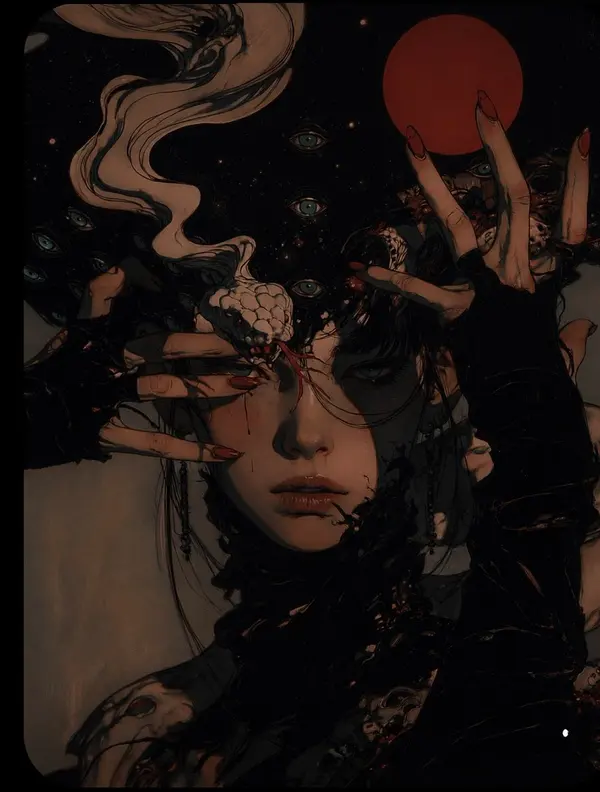
A highly detailed surreal gothic horror portrait of a pale young woman with short black hair, centered in a tight vertical composition. Her expression is calm, melancholic, haunting, and emotionally distant, with heavy dark eye makeup, tired eyes, delicate facial features, and subtle imperfections.
Multiple pale hands with long sharp red-painted nails emerge around her face, partially covering her eyes and framing her head in an unsettling ritualistic composition. A pale snake-like creature rests across her forehead and nose, with intricate scales and subtle organic details.
Behind her is a deep black cosmic void filled with tiny stars, floating particles, and numerous eerie turquoise eyes staring from the darkness. A large muted crimson-red circular moon/orb hangs in the upper background. Long flowing pale hair-like tendrils sweep dramatically across the upper-left portion of the composition and blend into the surrounding darkness.
She wears dark black clothing with layered fabric, organic textures, subtle metallic details, chains, jewelry, and distressed elements. The entire scene should feel mysterious, occult, surreal, gothic, dreamlike, and psychologically unsettling.
Keep the original muted color palette: black, charcoal, dusty beige, muted teal, faded blue, deep crimson, and subtle warm skin tones. Make the image significantly moodier with low-key cinematic lighting, deep shadows, soft highlights, subdued saturation, atmospheric darkness, subtle film grain, textured brushwork, and dramatic chiaroscuro.
Highly detailed dark fantasy illustration, surreal editorial artwork, hand-painted texture, intricate linework, painterly shading, cinematic composition, haunting atmosphere, sophisticated gothic aesthetic, sharp facial details, layered visual storytelling, vertical 4:5 composition.
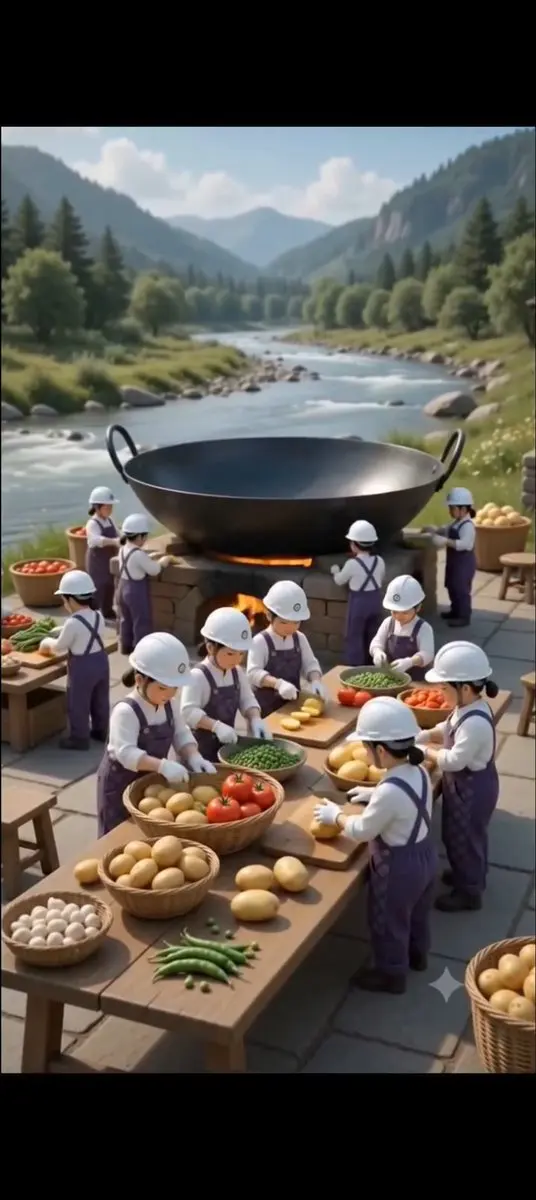
Create a cinematic animated video based on the uploaded image. Keep the same beautiful mountain valley, flowing river, giant cooking wok, wooden tables, vegetables, potatoes, tomatoes, and the tiny chefs wearing white helmets and purple aprons.
The tiny chefs actively prepare food around the giant wok. Some chop vegetables, some stir the huge wok with large utensils, while others carry baskets of fresh vegetables. Show one tiny chef happily serving freshly cooked food to another chef, who tastes it with a spoon and smiles. Steam rises naturally from the wok, flames flicker under it, and the river flows gently in the background
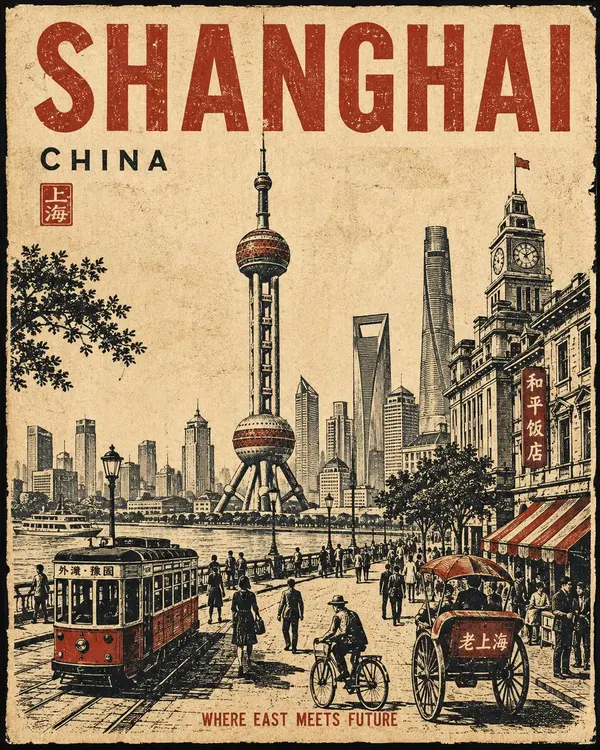
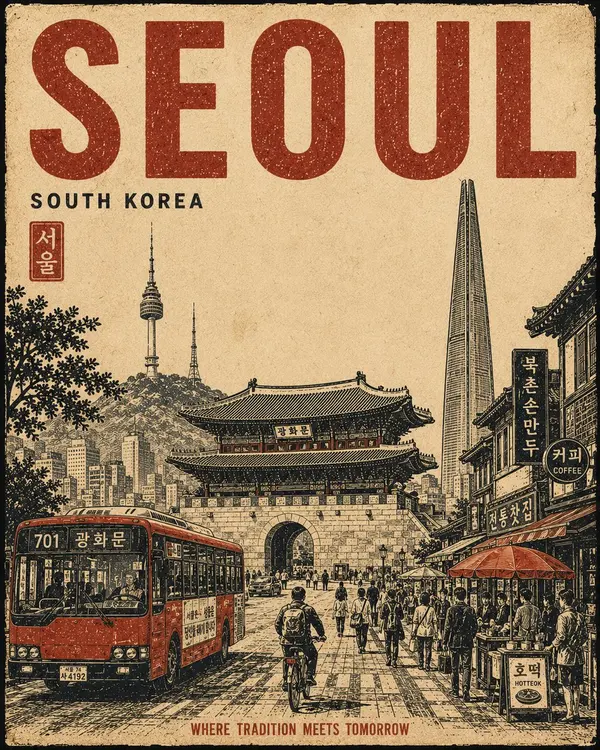
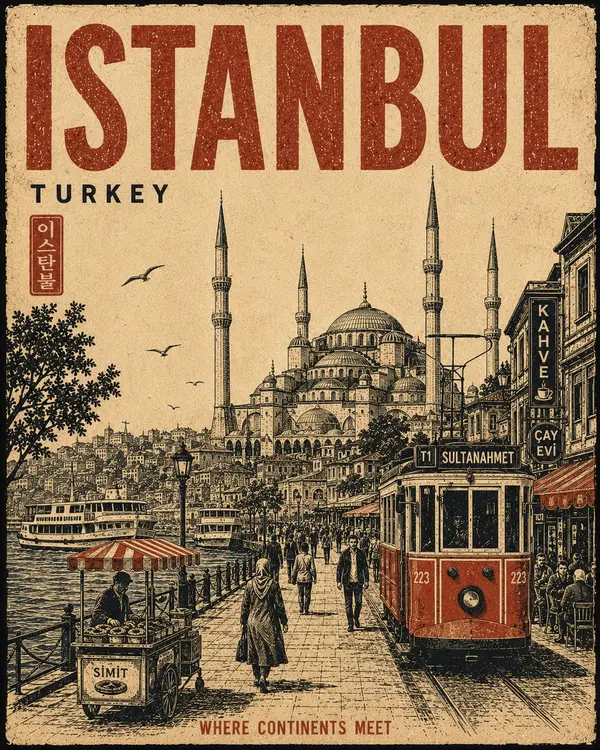
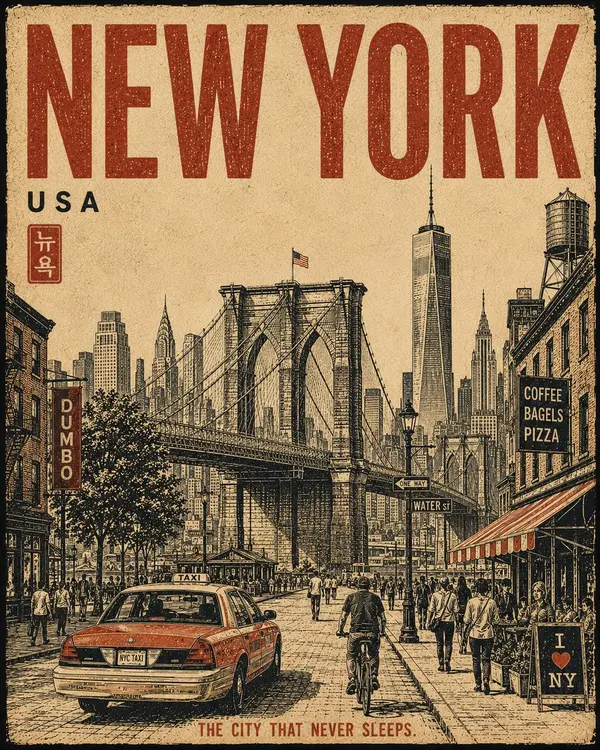
Create a premium 4:5 vertical vintage travel poster for [CITY], [COUNTRY]. Follow the same visual structure, composition, proportions, and artistic treatment in every generation. The result must feel like part of one consistent collectible poster series.
FIXED COMPOSITION
Use a single unified street-level scene, not a collage. Place one dominant central architectural or cultural subject as the visual anchor, occupying approximately 50–60% of the central image area. Integrate 2–4 recognizable [CITY] landmarks or architectural details naturally into the same environment, with clear foreground, middle-ground, and background depth. Never make landmarks appear as floating objects or separate illustrations.
Add subtle authentic city-life elements around the main subject: characteristic transportation, streets, buildings, cafés, shops, signs, pedestrians, cyclists, local objects, food, trees, and surrounding landscape. Only include details that genuinely belong to [CITY].
FIXED LAYOUT
Keep generous negative space around the main subject. Maintain a strong visual hierarchy:
CITY NAME → MAIN SUBJECT → SUPPORTING CITY DETAILS → SMALL SECONDARY TEXT.
Do not change the overall placement or scale relationship between these elements between generations.
FIXED MATERIAL & COLOR
Use an aged warm-ivory paper background with visible fibers, subtle stains, faded areas, rough edges, and authentic printed-paper texture. Use only three dominant colors: warm ivory, charcoal/black, and one signature accent color associated with [CITY]. The accent color must remain selective and never dominate the entire image.
FIXED ART STYLE
Handmade vintage linocut + screen-print travel poster. Bold carved shapes, strong silhouettes, limited-color printing, rough ink texture, distressed halftone grain, slight ink misregistration, imperfect hand-cut edges, subtle fading, expressive perspective, and sophisticated editorial composition. Keep the artwork intentionally tactile and slightly imperfect.
TYPOGRAPHY
Integrate [CITY] as large, bold, hand-printed typography in a consistent prominent position. Add [SHORT CITY PHRASE] as smaller secondary text. Typography must look physically printed into the artwork—slightly distressed, imperfect, and naturally integrated. Keep the wording exactly as provided; do not invent additional text.
CITY IDENTITY
The composition must immediately communicate [CITY] through its architecture, street atmosphere, transportation, objects, landscape, and cultural details—not merely through famous landmarks. Select details that naturally coexist in one believable scene.
DO NOT
Do not use photorealism, glossy 3D rendering, gradients, excessive colors, modern digital effects, random landmarks, floating objects, tourist-collage layouts, excessive text, or ultra-clean vector graphics. Do not change the established composition, palette, typography hierarchy, or artistic style.
FINAL GOAL
A bold, sophisticated, culturally authentic vintage collectible travel print with one continuous visual story. It should look like a carefully screen-printed European travel poster from the same established design series, while remaining uniquely recognizable as [CITY], [COUNTRY].
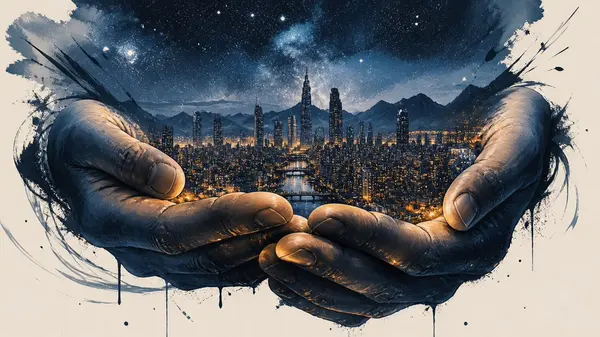
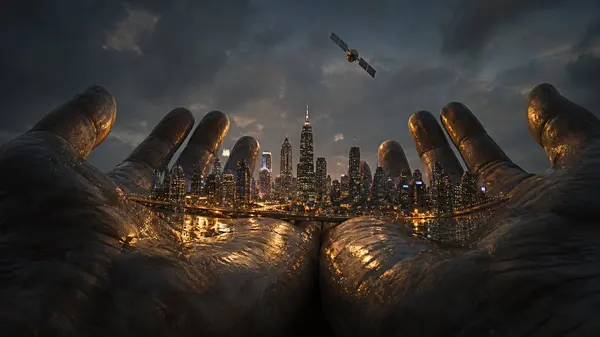
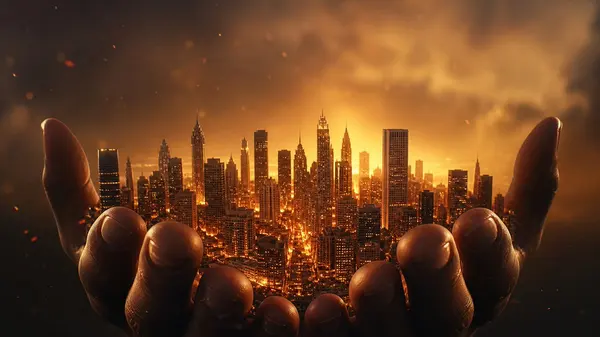
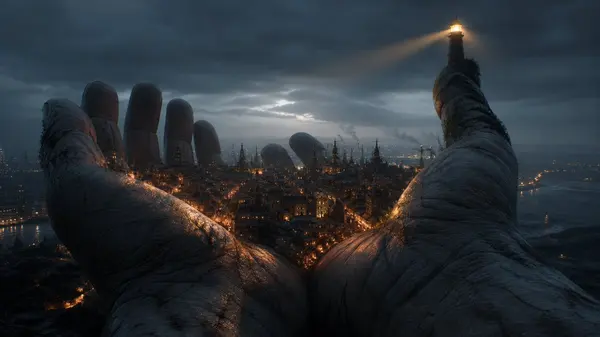
Two enormous hands hold an entire metropolis in their palms, the city lights reflecting across their fingers.
1. Art: Fine art illustration of two colossal hands cradling a sprawling metropolis, their palms cupped like a living basin. bold graphic ink strokes define the fingers, while gouache washes of deep indigo and amber capture city lights shimmering across knuckles. negative space frames the composition, expressive mark-making suggesting motion, an ethereal starry sky above featuring in a fine art illustration style, under blue hour twilight, solitary isolation atmosphere, handheld camera. consistent identity across frames facial expression consistency rich background detail rich skin detail with natural pores real physics no artifacts.
2. Cinematic: Widescreen cinematic frame of two colossal, weathered hands cradling a sprawling metropolis at dusk, warm amber window-light and neon reflections pooling across their creased palms like liquid gold. shot on anamorphic 35mm, shallow depth-of-field, low-angle tilt, kodak vision3 500t grade, a lone satellite drifting overhead as a poetic counterpoint featuring in a cinematic film still style, under natural overcast daylight, humble grounded authenticity atmosphere, slow push-in. perfect liquid physics simulation no AI-style warping rich background detail consistent identity across frames physically accurate shadows accurate reflections and refractions.
3. Ads: Luxury brand campaign shot of two colossal hands cradling a glowing metropolis, warm sunset light spilling through city towers and reflecting off polished skin, cinematic 35mm anamorphic lens, shallow depth of field, rim-lit fingers with soft golden highlights, dusk atmosphere, nostalgic amber and honey color grade, subtle haze and floating dust particles, poster-ready composition with negative space above featuring in a high-end advertising campaign style, under glowing firelight, building dread atmosphere, macro beauty shot. accurate reflections and refractions facial expression consistency no AI-style warping fluid cloth simulation sharp focus perfect motion blur only on moving elements.
4. Bizarre: Luxury brand campaign shot of two colossal hands cradling a glowing metropolis, warm sunset light spilling through city towers and reflecting off polished skin, cinematic 35mm anamorphic lens, shallow depth of field, rim-lit fingers with soft golden highlights, dusk atmosphere, nostalgic amber and honey color grade, subtle haze and floating dust particles, poster-ready composition with negative space above featuring in a high-end advertising campaign style, under glowing firelight, building dread atmosphere, macro beauty shot. accurate reflections and refractions facial expression consistency no AI-style warping fluid cloth simulation sharp focus perfect motion blur only on moving elements.
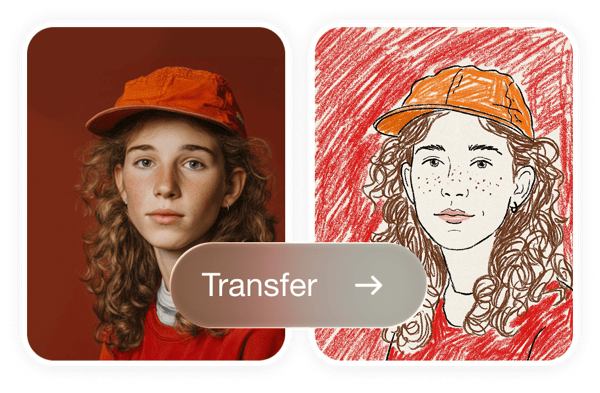
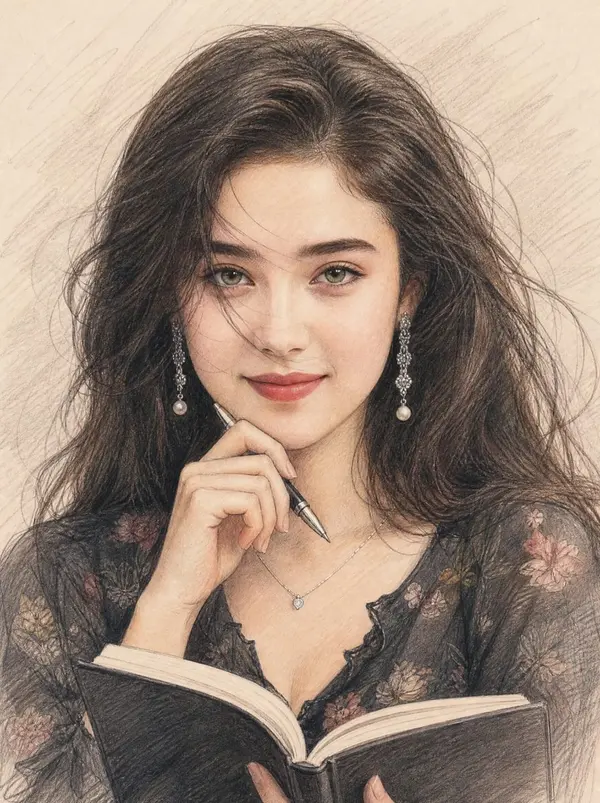
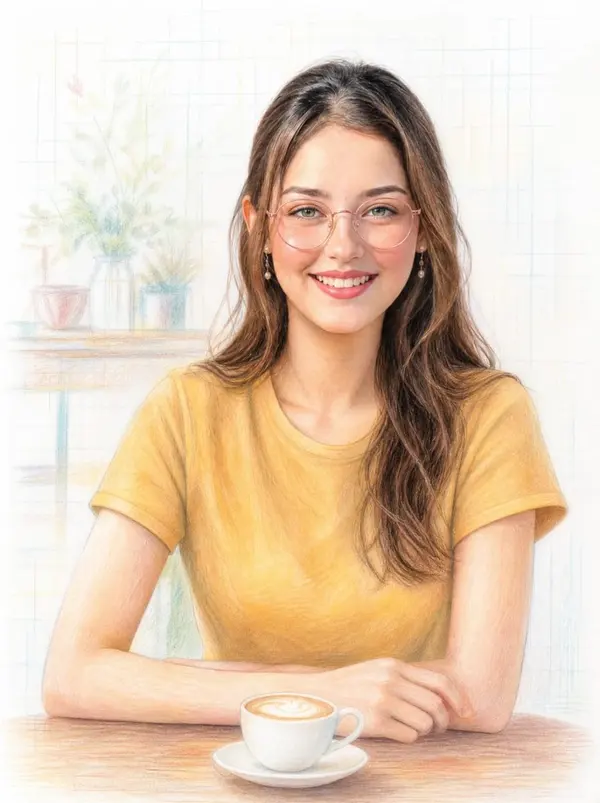
Color pencil sketch style, classic artistic drawing style with highly detailed rendering.
A beautiful young woman facing the camera. Facial features should follow reference image 1, while the hairstyle should not follow reference image 1.
She wears a dark floral sheer blouse paired with long, voluminous dark brown hair. Her hair has a lot of volume, with a few strands gently brushing across her face, creating a cold yet captivating beauty.
She wears silver dangling earrings and a simple collarbone necklace. Her makeup is refined, her skin is fair and delicate. One hand holds an open notebook, while the other hand holds a pen lightly touching her chin as she appears to be deeply thinking about something.
The brush gently outlines the portrait with delicate strokes, allowing the character’s charm and expression to naturally emerge. The background is warm ivory beige, with casually drawn pencil line textures. The composition is simple, bright, smooth, and elegant.
Masterpiece artwork, front-facing close-up portrait, upper-body close shot, highly detailed colored pencil illustration.
Use the uploaded image strictly only for face and identity reference. Preserve the same feminine identity naturally.
Create a 4:5 aspect ratio, premium-quality soft pastel and colored-pencil portrait illustration of the woman sitting at a cafe table. The final image should feel like a high-end artist-made portrait, elegant, refined, delicate, and visually polished — not like a basic sketch, comic drawing, or simple line-art illustration.
Visual Goal:
The artwork must have a soft luxurious handmade feel, with refined blending, gentle tonal transitions, delicate shading, and a clean premium finish. It should look like a beautifully crafted professional illustration on fine textured white paper, with subtle colored-pencil rendering and soft pastel depth. Keep the image airy, graceful, and artistically sophisticated.
Composition:
Vertical portrait, upper-body framing. The woman is centered, facing the camera directly, sitting calmly behind a wooden cafe table. Her arms rest naturally and softly on the table in a relaxed and elegant pose. Place a small white ceramic coffee cup with soft latte foam on a saucer in the foreground near the bottom center. The cup should be neatly drawn, slightly understated, and not oversized.
Character Details:
She has a warm cheerful smile, gentle friendly eyes, delicate feminine facial features, smooth clear skin, thin round pink glasses, and small elegant dangling earrings. Keep the hair matching the reference image: same dark brown tone, same length, same soft wavy flow, smooth volume, center-parted look, and soft natural framing around the face.
Outfit:
She wears a simple mustard-yellow short-sleeve t-shirt. Keep it minimal, clean, and softly shaded, with subtle fabric form and elegant simplicity.
Background:
Use a bright clean white background with a very subtle pastel grid/sketch texture. Keep the lines faint and soft, in pale blue, mint, and light beige tones. Behind the subject, add very soft, light, and blurred background elements such as a faint table or shelf and a subtle plant or decor object, rendered in an airy pastel way so they remain barely visible and do not distract from the portrait. These background objects should feel delicate, minimal, and softly dissolved into the scene, helping the image feel premium, elegant, and softly atmospheric. The background must remain minimal, airy, and uncluttered, helping the portrait feel clean and premium.
Rendering Style:
Soft pastel + colored-pencil portrait rendering, refined and delicate.
Very soft edges, smooth shading, subtle paper texture, and light pencil presence.
Facial rendering should be polished, graceful, and clean, with delicate color blending and natural softness.
Keep the overall finish premium, elegant, balanced, and aesthetically pleasing.
The image should feel like a high-end editorial portrait illustration or luxury stationery artwork, not a rough sketch.
Important Style Restrictions:
Do not make it look like a cartoon, comic, anime, flat vector, rough sketch, ink drawing, or children’s book illustration.
Do not use harsh outlines, strong contour lines, heavy cross-hatching, exaggerated features, or overly visible pencil strokes.
Do not make the hair too short, too fluffy, or restyled.
Do not over-sharpen the image.
Do not make the coffee cup too large or too detailed.
Avoid:
heavy black outlines, comic style, rough pencil sketch look, amateur illustration feel, harsh linework, flat shading, watercolor wash dominance, messy composition, distorted glasses, awkward hands, extra fingers, text, logo, watermark.
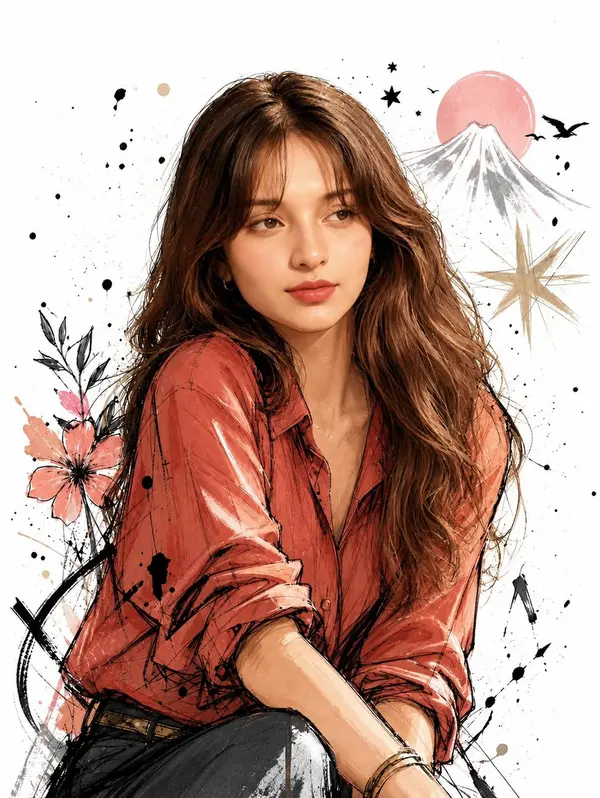
Create a high-detail watercolor-and-ink editorial portrait of a young woman with long, wavy brown hair, wearing a rust-red shirt with rolled-up sleeves and dark jeans. She sits in a relaxed pose with a soft, natural expression. Surround her with delicate flowers, black ink splashes, a snowy mountain, a soft pink sun, flying birds, stars, and a subtle beige starburst on a clean white background. Use elegant hand-drawn linework, warm earthy tones, painterly watercolor textures, realistic facial details, cinematic composition, and refined illustration aesthetics. No text, no inset photo, no watermark.
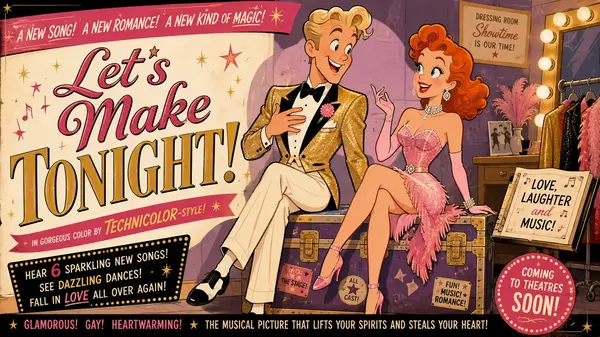
Mid-century theatrical cartoon still promotional Hollywood movie trailer banner featuring a energetic song-and-dance man with wavy blond hair and a bright grin, wearing a sparkling stage jacket and bow tie, and a lively leading lady with vibrant red curls and joyful eyes, wearing a glittery pink performance dress, seated on a prop trunk backstage. Stage them in a lighthearted, musical, good-humored interaction, with both characters fully visible, relaxed, and clearly reacting to each other as if ready to burst into song. Design the figures with exaggerated early-1950s animation caricature: clean black contour lines, sharply simplified anatomy, elegant angular silhouettes, expressive eyebrows, stylized facial shapes, graceful hand gestures, and cheerful readable expressions. Render the entire image in a unified traditional cel-animation aesthetic, with the background following the same stylized visual language as the characters, using flat opaque colors, minimal hard-edged shading, simplified furniture and décor, subtle hand-painted texture, controlled perspective, and crisp theatrical staging. Use a vibrant showbiz palette of hot pink, gold, cream, and soft purple and maintain a witty, charming, visually snappy mood.
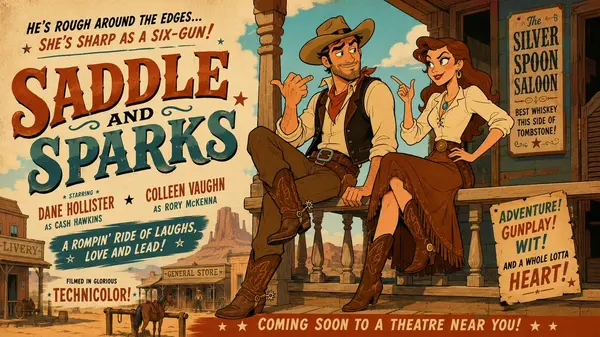
Mid-century theatrical cartoon still promotional Hollywood movie trailer banner featuring a rugged cowboy with a short beard and steady gaze, wearing a classic western shirt, vest and cowboy hat, and a bold frontier woman with long chestnut hair and a determined smile, wearing a practical blouse and riding skirt, seated on a wooden porch railing outside a dusty saloon. Stage them in a lighthearted, spirited, good-humored interaction, with both characters fully visible, relaxed, and clearly reacting to each other with playful tension. Design the figures with exaggerated early-1950s animation caricature: clean black contour lines, sharply simplified anatomy, elegant angular silhouettes, expressive eyebrows, stylized facial shapes, graceful hand gestures, and cheerful readable expressions. Render the entire image in a unified traditional cel-animation aesthetic, with the background following the same stylized visual language as the characters, using flat opaque colors, minimal hard-edged shading, simplified furniture and décor, subtle hand-painted texture, controlled perspective, and crisp theatrical staging. Use a dusty western palette of warm sand, deep brown, soft turquoise, and cream and maintain a witty, charming, visually snappy mood.
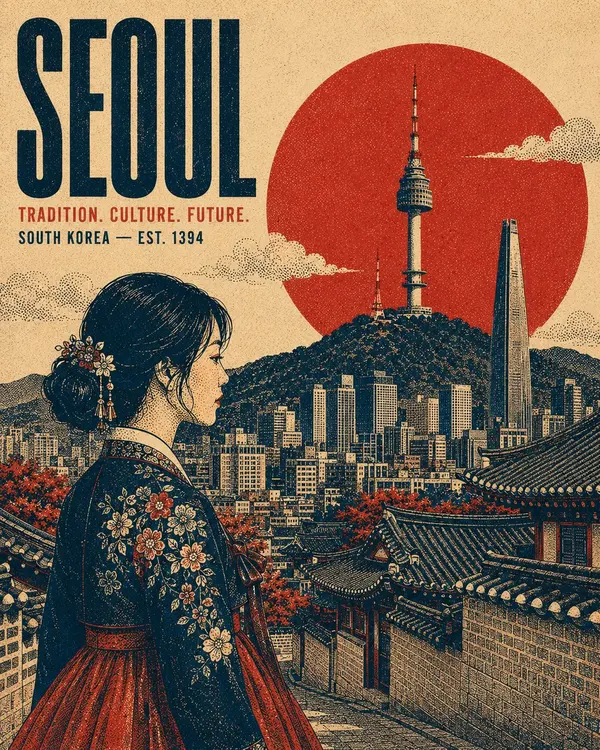
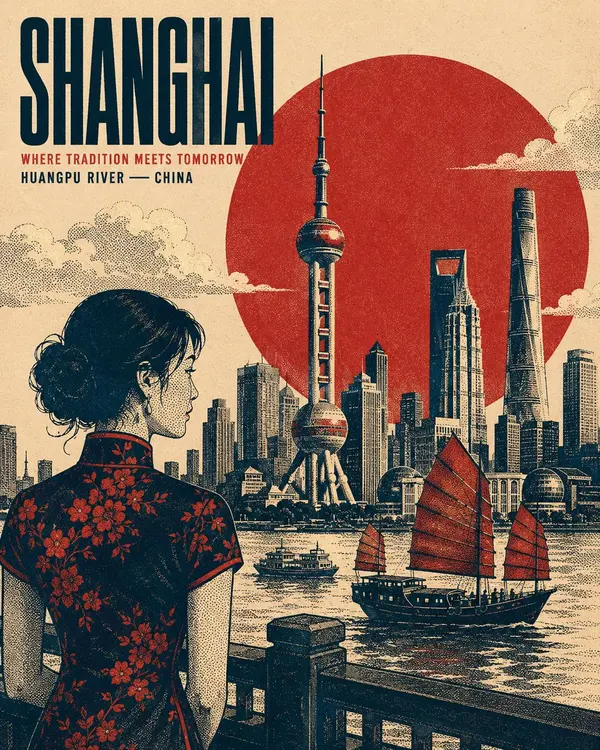
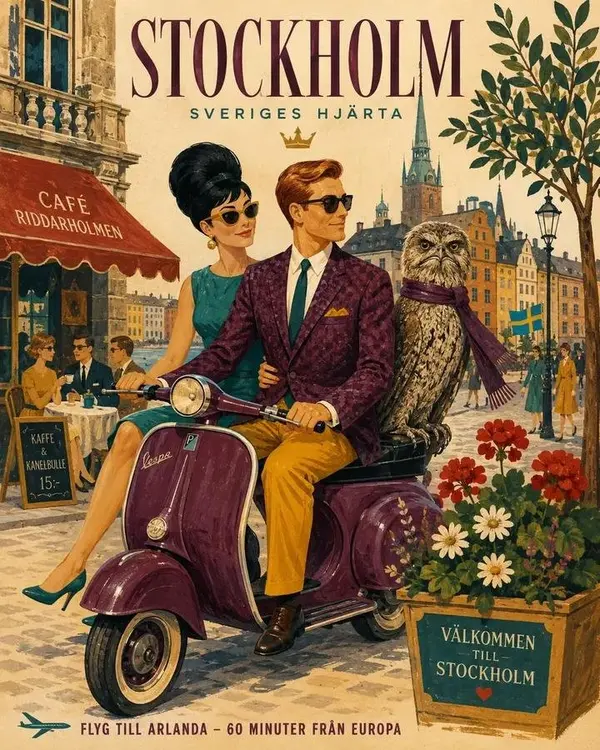
Create a premium 4:5 vertical retro screen-print poster illustration centered on [SUBJECT / LANDMARK / CITY / ERA]. The composition should feel like a refined vintage travel or cultural print, while remaining adaptable to any location, historical period, landmark, or subject.
TYPOGRAPHY: Place the primary title "[MAIN TITLE]" in a bold, condensed uppercase sans-serif, positioned within a balanced area of negative space. Add a smaller supporting line "[SECONDARY HEADLINE / LOCATION / DATE]" beneath it. Maintain strong typographic hierarchy, restrained spacing, and an authentic archival-poster character.
MAIN SUBJECT: Feature [PRIMARY SUBJECT] as the dominant visual element, positioned within the lower or side third of the composition. Use a distinctive pose, silhouette, or profile that communicates the character of the subject. Include carefully rendered defining details, natural contours, expressive features, clothing or architectural details, and subtle highlights without making the artwork photorealistic.
GEOMETRIC ANCHOR: Introduce one bold, simple geometric shape behind or around the main subject to create visual separation and establish a strong graphic focal point.
BACKGROUND: Construct the environment as several flat, layered graphic planes rather than a conventional realistic scene. Use recognizable elements associated with [LOCATION / SUBJECT] — distant silhouettes, architectural forms, structural details, vegetation, terrain, atmospheric elements, or cultural motifs. Avoid a strong vanishing point. Build depth through overlapping shapes, scale, linework, and tonal density. Render clouds, smoke, mist, foliage, or atmospheric details as controlled stippled clusters where appropriate.
RENDERING STYLE: Authentic vintage screen-print / silkscreen poster aesthetic. Create all tonal modeling exclusively through stippling, halftone patterns, and varying dot density — concentrated dots for shadows and sparse dots for highlights. No smooth gradients, airbrushing, photorealistic shading, or digital 3D rendering. Use crisp contour lines with consistent visual weight, subtle riso-style registration shifts, imperfect ink edges, natural paper grain, and faint woven-print texture. The result should feel physically printed rather than digitally rendered.
COLOR SYSTEM: Use exactly four carefully selected high-contrast colors appropriate to the subject: [COLOR 1], [COLOR 2], [COLOR 3], [COLOR 4]. Do not introduce additional hues. Generate intermediate tonal values exclusively through stipple density, halftone overlap, and ink coverage, never by adding new colors.
COMPOSITION: Strong editorial balance, clear focal hierarchy, generous negative space, layered depth, bold silhouette design, authentic vintage graphic-design proportions, and carefully controlled visual density. Keep the artwork sophisticated, collectible, and suitable for a premium travel or cultural poster.
OUTPUT: 4:5 vertical aspect ratio, edge-to-edge poster composition, high detail, crisp print-ready appearance, cohesive screen-print texture, no modern photographic elements.
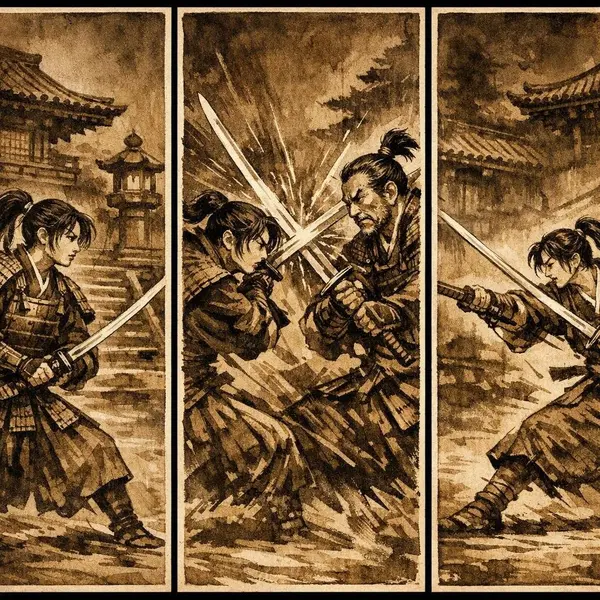
Create a vertical triptych (three tall panels side by side) in a classic Japanese ukiyo-e and ink-wash style.
Subject: A young samurai girl and an older samurai man fighting with katanas in front of old-style Japanese architecture (wooden temples, tiled roofs, shoji screens, stone lanterns).
Color and mood: Overall brownish, sepia-toned palette with an aged-paper texture. The background should be darker than the foreground, using deep browns and near-black shadows to create depth and drama.
Composition:
- Left panel: The two warriors facing off, swords drawn, tense stance.
- Middle panel: Mid-clash, blades crossing, sparks and motion lines, dynamic poses.
- Right panel: A decisive strike moment, one warrior lunging forward, the other parrying.
Keep the characters’ faces, armor, and clothing consistent across all three panels. Use strong ink outlines, subtle watercolor washes, visible brush strokes, and muted earth tones (ochre, umber, sepia, dark brown). The overall feel should be historical, cinematic, and dramatic.
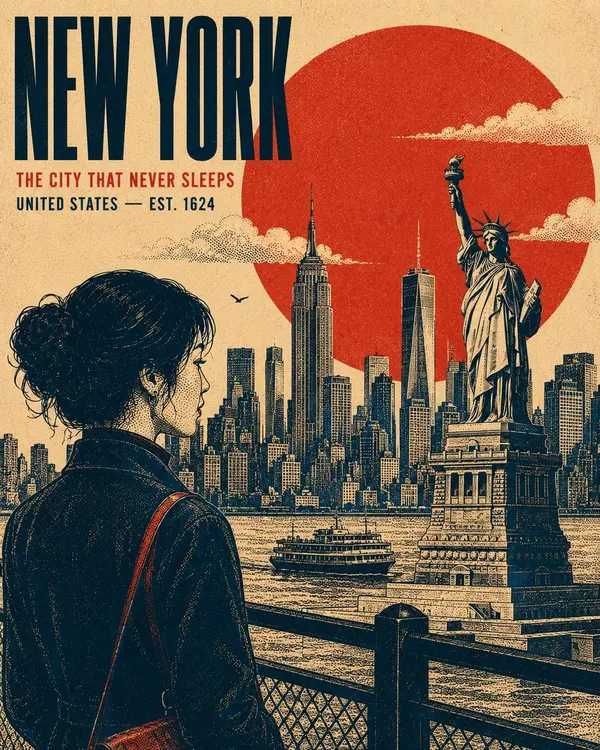
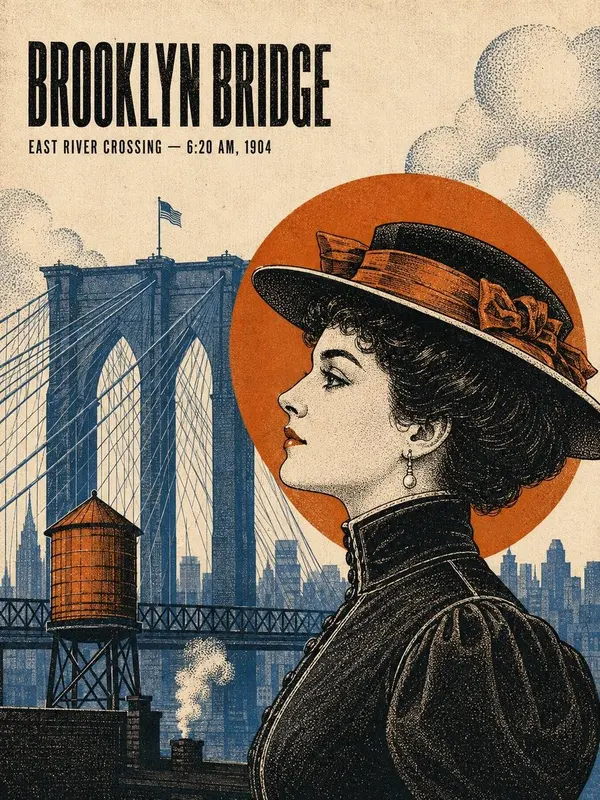
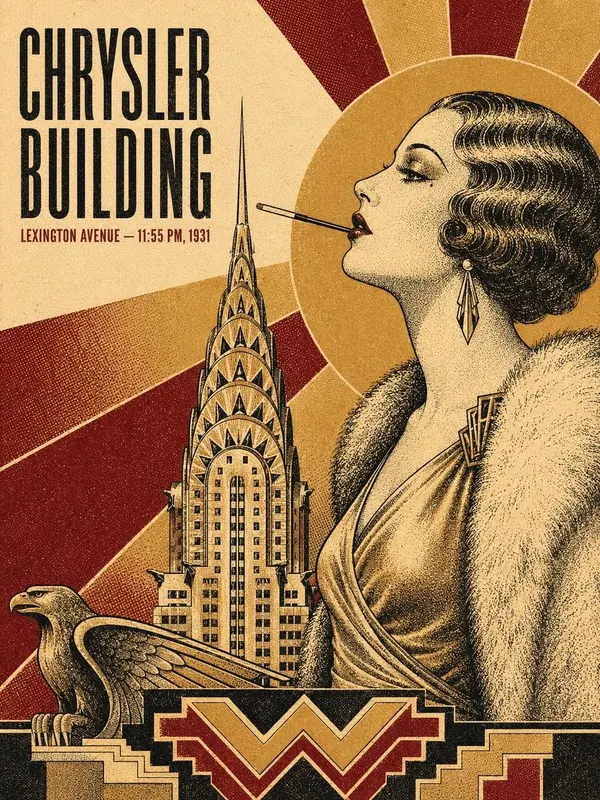
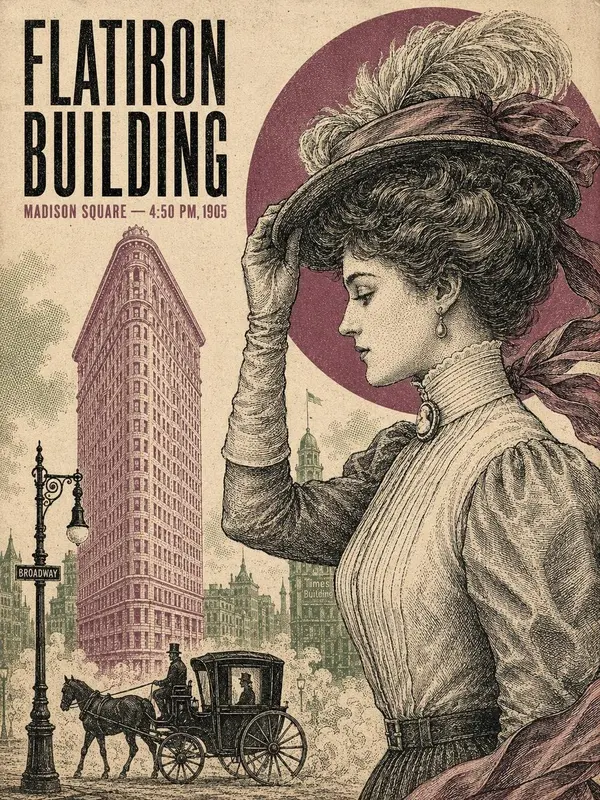
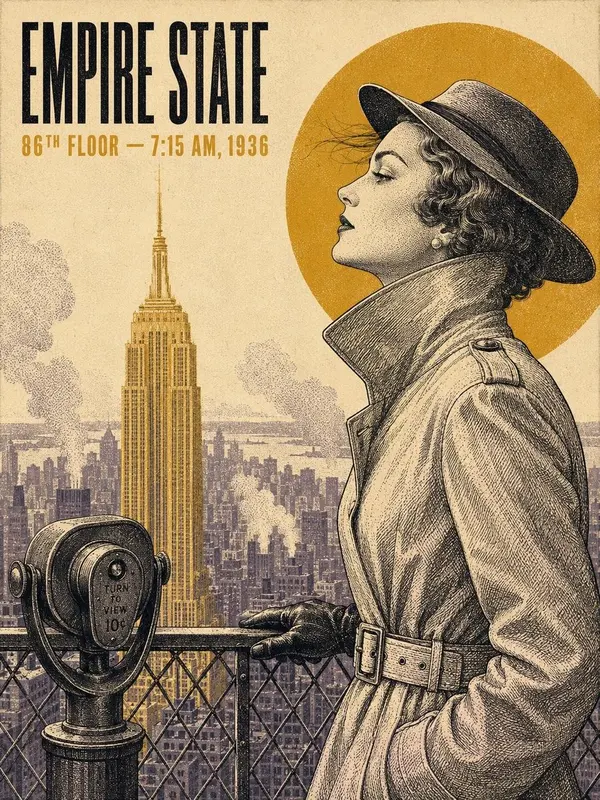
Create a sophisticated vintage New York City travel poster inspired by early 20th-century American editorial illustration and Art Deco advertising. Feature a glamorous woman in period fashion as the main subject, rendered in detailed engraved linework and vintage halftone printing.
She wears an elegant 1900s–1930s-inspired outfit with a dramatic wide-brim hat, gloves, earrings, tailored coat or dress, and refined accessories. Pose her in profile or three-quarter view, looking thoughtfully toward a famous New York landmark.
Place a recognizable NYC landmark prominently in the background — Brooklyn Bridge, Chrysler Building, Flatiron Building, or Empire State Building — surrounded by an atmospheric historical Manhattan skyline. Add period details such as elevated railways, water towers, vintage automobiles, horse-drawn carriages, street lamps, observation telescopes, steam rising from rooftops, and subtle architectural details appropriate to the era.
Use a limited retro color palette: warm parchment/cream paper, charcoal black, muted navy blue, burnt orange, ochre gold, deep burgundy, and dusty brown. Add large geometric Art Deco shapes, circular sun halos, diagonal rays, architectural framing, fine stippled shading, crosshatching, distressed ink, paper grain, faded printing, and authentic screen-print imperfections.
Typography should feel like a genuine 1920s–1930s travel advertisement: large bold condensed uppercase serif/sans-serif title at the top, a smaller location and historical time beneath it, and tasteful decorative text elements around the composition. Keep the typography clean, correctly spelled, and integrated naturally into the artwork.
Overall aesthetic: vintage American travel poster, Art Deco, 1930s editorial illustration, engraved lithograph, halftone print, hand-printed texture, nostalgic New York atmosphere, elegant fashion illustration, museum-quality poster design, highly detailed, cohesive composition, authentic aged paper texture, vertical poster format, 4:5 aspect ratio.
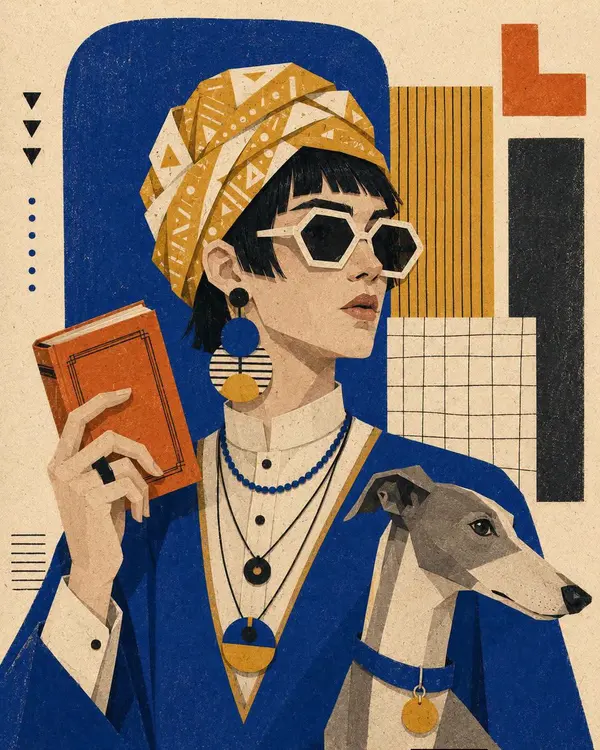
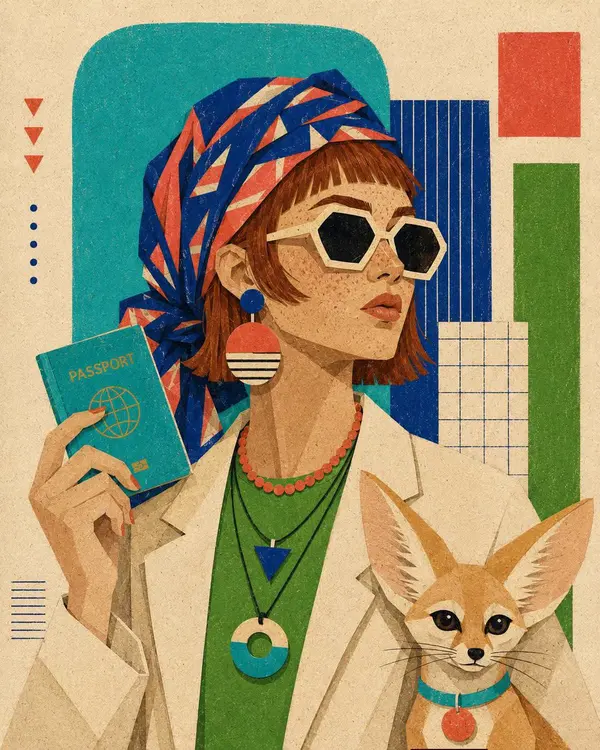
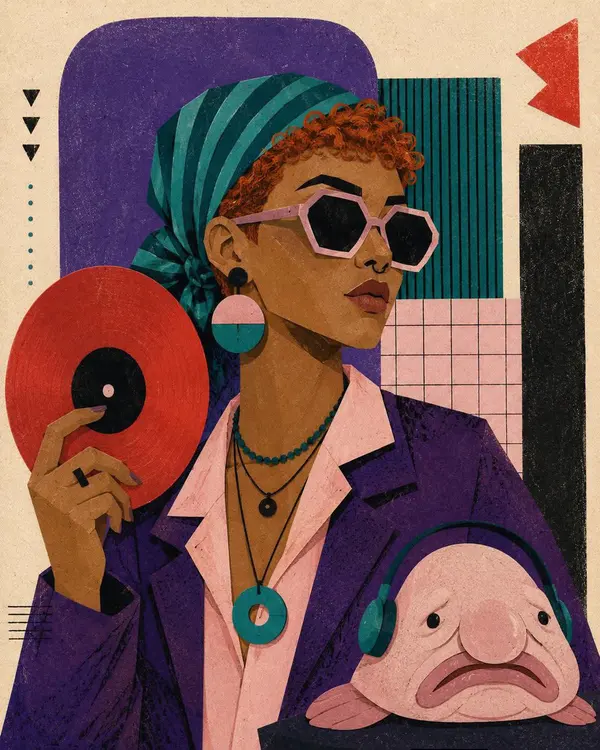
Waist-up editorial portrait of [CHARACTER] in a calm three-quarter pose, with [HAIR], wearing [CLOTHING], oversized geometric sunglasses, bold circular earrings, layered necklaces, and holding [OBJECT] near the shoulder. Stylized [ANIMAL] beside the figure, constructed from the same flat cut-paper shapes and simplified graphic anatomy. Hand-cut paper collage with angular facial planes, minimal features, sharp silhouette edges, flat opaque color blocks, visible paper fibers, subtle screen-print grain, slight color misregistration, dry crayon-like marks, and no dimensional modeling. Controlled [COLOR] palette. Background made from [ELEMENTS], arranged as overlapping rectangles, rounded panels, striped inserts, hand-drawn grids, and small geometric accents on warm speckled off-white paper. Maintain a balanced modern editorial composition, strong negative space, crisp color separation, and tactile handmade print aesthetics.
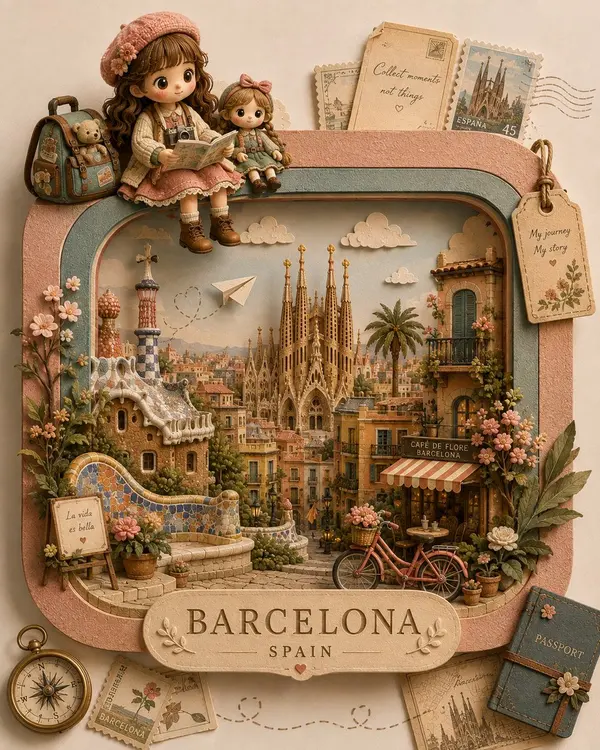
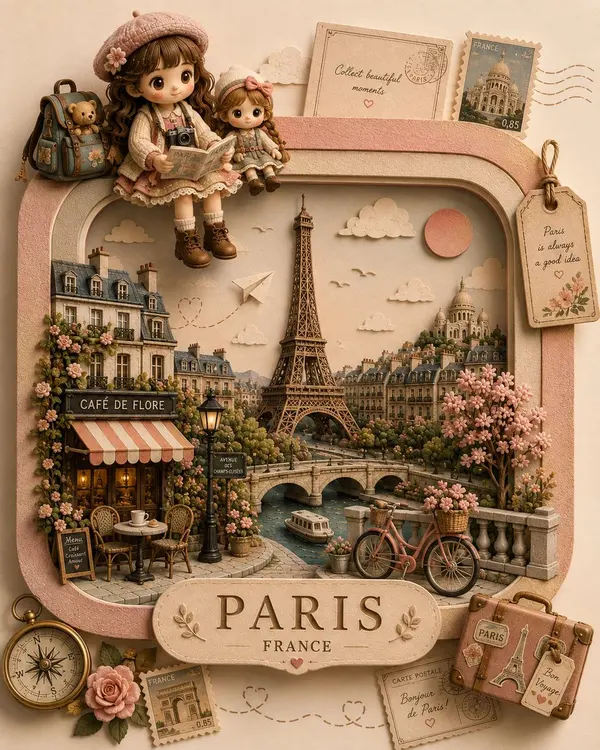
Create a premium handcrafted 3D paper-craft travel diorama centered around a little girl and her beloved doll on a magical journey.
adorable young girl doll character sitting on the upper edge of the diorama with her favorite small doll companion beside her. She wears a charming vintage travel outfit — a soft knitted cardigan, pleated skirt, little boots, cute hat, and a tiny backpack. She holds a miniature travel journal or map, while her doll is dressed in a matching outfit and carries a tiny suitcase.
The main scene inside the dimensional frame should represent [DESTINATION] as a magical miniature world. Include its most recognizable architecture and landscapes, but reinterpret everything as handcrafted toys and paper sculptures: tiny buildings, colorful streets, flowers, trees, bridges, cafés, lanterns, local decorations, and a small pathway leading into the scene.
Add charming storytelling details:
The girl’s doll sitting beside her as her travel companion
Tiny suitcase covered with travel stickers
Miniature teddy bear peeking from the backpack
A tiny camera hanging around the girl’s neck
Small postcards and stamps scattered around the frame
A miniature paper airplane flying through the scene
A tiny map with a dotted route
Handcrafted flowers and plants around the foreground
Use a soft pastel vintage palette of dusty pink, warm cream, terracotta, muted teal, sage green, peach, and warm brown.
The entire artwork should feel like a luxury handcrafted children’s storybook mixed with a vintage travel scrapbook, using layered cardstock, paper quilling, embossed paper, miniature clay details, fabric textures, stitched leather accents, and delicate hand-painted surfaces.
Make the girl and her doll especially charming and expressive, with a cute collectible-doll aesthetic, oversized curious eyes, soft handcrafted facial details, and a warm adventurous personality.
Add a large raised plaque at the bottom reading:
[DESTINATION]
[COUNTRY]
Surround the composition with subtle travel elements such as a compass, postage stamps, luggage tags, leaves, postcards, and a dotted travel route.
Soft warm studio lighting, realistic miniature shadows, tactile paper fibers, shallow depth of field, premium product photography, highly detailed handcrafted textures, whimsical cinematic atmosphere, elegant composition, cozy nostalgic feeling, museum-quality miniature diorama, 8K.
Avoid: photorealistic humans, plastic-looking 3D characters, excessive text, clutter, harsh colors, modern objects, generic fantasy scenery.
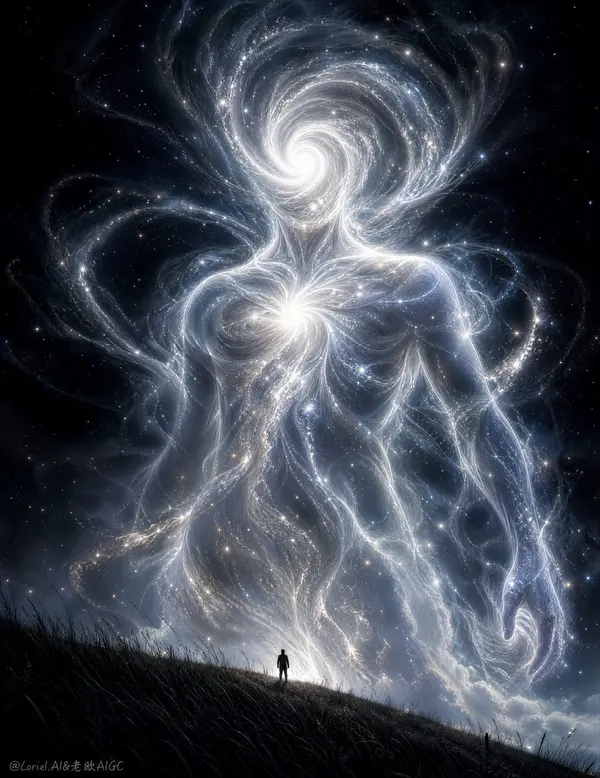
Create an ultra-premium vertical cosmic fantasy illustration that preserves the exact core structure, emotional magnitude, and surreal visual hierarchy of the image, while intensifying the integration between the radiant vortex head and the full-body cloud form so the entire giant reads as one continuous manifestation of cosmic consciousness. One tiny solitary human figure stands on a dark grassy slope in the lower foreground, while a colossal translucent humanoid being made of white starlit vapor, flowing cosmic filaments, and galaxy-scale mist towers above them, filling the center and upper frame like a living celestial revelation. The final artwork must feel sacred, overwhelming, contemplative, and curatorially precise, with a deep black universe, unified nebula anatomy, and a clearly organized hierarchy of luminous force. No readable text, no watermark, no logo, no real names.
Core composition:
Use a tall vertical composition dominated by a dark star-filled cosmic void. Place one small human silhouette in the lower-middle foreground, standing alone on a sloped ridge of dark grass, facing upward toward the giant entity. Above and beyond the figure, build one monumental humanoid form rising out of mist, starlight, and flowing galactic currents. The humanoid should occupy most of the center frame, with shoulders, chest, waist, and one descending arm clearly readable, while the head dissolves into a brilliant spiral vortex of white light. The whole composition must immediately read as a meeting between mortal scale and cosmic intelligence.
Main subject logic:
The true subject is the relationship between the tiny human witness and the immense celestial body. The giant figure must feel neither male nor female, but ancient, sentient, and sublime. It should appear composed of translucent flowing space-material rather than flesh, as if the night sky has temporarily taken human form. The human below remains almost featureless, a small anchor of scale, vulnerability, and awe.
Unified vortex-body structure:
Strengthen the structural continuity between the head vortex and the body cloud mass. The spiral head must not feel like a separate glowing effect placed on top of a torso; instead, it must appear to grow directly out of the same white-silver vapor anatomy as the shoulders, neck zone, chest, and upper back. Let the rotational motion of the vortex feed visibly into the chest currents, shoulder contours, and the long vertical body streams, creating one coherent circulation system from head to torso to lower mist body. The entire figure should feel as though it is being continuously formed by one cosmic tidal flow.
Orbit impact enhancement:
Increase the first-glance pressure of the head vortex and central chest glow. The brightest focal intensity should occur at the vortex core and the upper sternum-chest region directly beneath it, making the viewer instantly read the image as “cosmic consciousness materializing into a body.” The head must feel more magnetically alive, and the upper torso must carry stronger illuminated structure so the giant’s presence lands immediately and powerfully.
Transit flow system:
Unify the entire image into a more rigorous celestial fluid system. The white luminous filaments, pale silver vapor layers, star-dust density, torso contours, arm edges, and the dark cosmic background must all belong to one coherent topographic-light grammar. Control the thickness, density, direction, and spacing of the linework so the head vortex, chest cavity, shoulders, and lower body all feel generated by the same universal current. The image should feel less like separate nebula effects and more like one elegant cosmic organism.
Humanoid design:
Construct the giant body from layered white and pale-silver vapor strands, translucent cosmic smoke, and luminous filament textures that define shoulders, chest, waist, and arms. The body must feel fluid yet anatomically legible, like a humanoid made from galaxies, breath, and stellar tides. The head is not a face; it is a radiant spiral or vortex of condensed cosmic light. This vortex must remain the brightest and most magnetic point, while visibly feeding the full-body cloud anatomy beneath it.
Cosmic flow and structure:
Let the surrounding night sky spiral inward and outward around the being, with curving nebula arms, drifting vapor ribbons, and subtle galaxy-like streaks feeding into the head vortex and then descending through the torso. The body edges should dissolve into the surrounding universe, especially at the shoulders, hips, and lower torso, so the being feels both formed and still becoming. Use fine line currents and layered transparency to create a sensation of enormous cosmic movement guided by one central circulation.
Foreground and terrain:
The foreground ridge should be dark and simple, with tall wind-brushed grass rendered in silhouette and minimal cool highlights. Keep it grounded, natural, and sparse. The tiny human figure stands still at the crest of the slope, centered slightly below the giant being, head lifted toward it. No buildings, no extra objects, no clutter.
Lighting and contrast:
The image must rely on powerful but refined dark-light contrast. Keep the sky deeply black but breathable, never muddy. The giant figure should glow in layered white-silver luminosity, with subtle cool-blue and faint warm glints embedded in the vapor body. The vortex-head must carry the strongest radiance, softly illuminating the upper chest and shoulder flows beneath it. Small warm gold sparks may appear sparsely inside the lower cosmic currents, but they must remain secondary.
Texture and detail:
Render the giant with exquisite detail: star-dust granules, mist filaments, flowing contour streams, nebula wisps, and soft translucency. The body should look like a cosmic storm seen through silk. The terrain should remain much simpler, serving only to root the scale. The entire image must feel clean, high-resolution, and curatorially precise.
Atmosphere:
The scene should feel silent, immense, and spiritually charged. The sky is not empty but alive with delicate field-stars, dust clusters, and drifting celestial haze. The giant must feel like an impossible revelation, at once intimate and incomprehensibly vast.
Mood:
sublime, cosmic, sacred, contemplative, solitary, awe-struck, transcendent, mysterious, infinite, celestial, overwhelming, luminous, mythic
Rendering style:
ultra-premium cosmic fantasy illustration, colossal translucent humanoid made of unified starlight and nebula filaments, radiant spiral vortex head structurally fused with full cloud body, tiny human on dark grassy slope, deep black starfield, museum-grade atmospheric concept art, world-class image quality, 8k
Negative prompt:
readable text, watermark, logo, real names, cluttered planets, generic sci-fi objects, muddy blacks, hard-edged CGI figure, disconnected vortex head, low-detail particles, cartoon rendering, oversaturated neon, messy composition, cheap galaxy effects, flat lighting, blurry linework
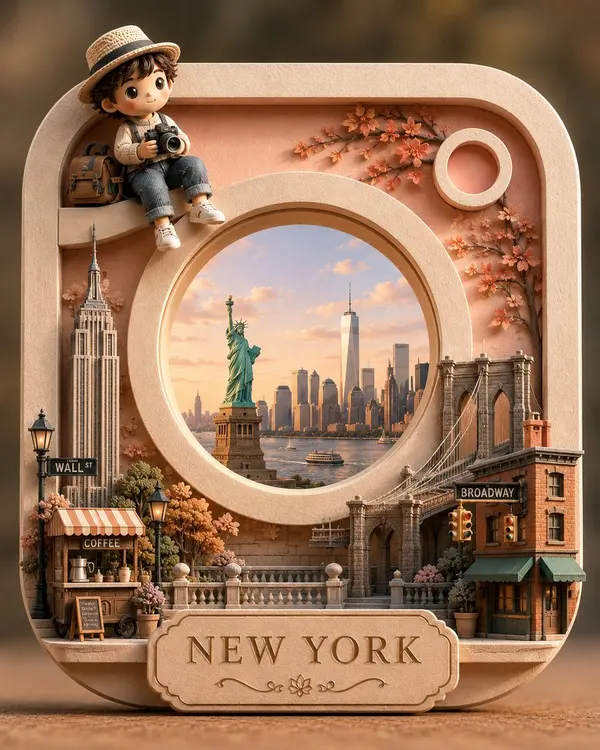
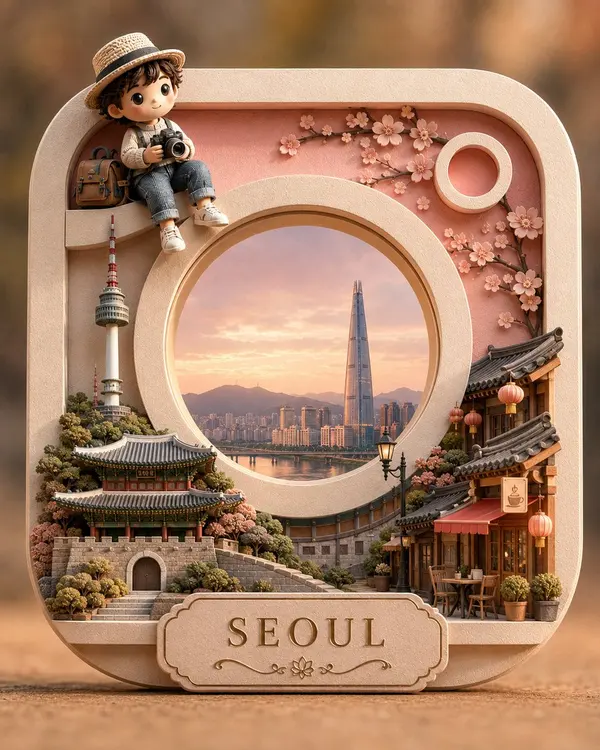
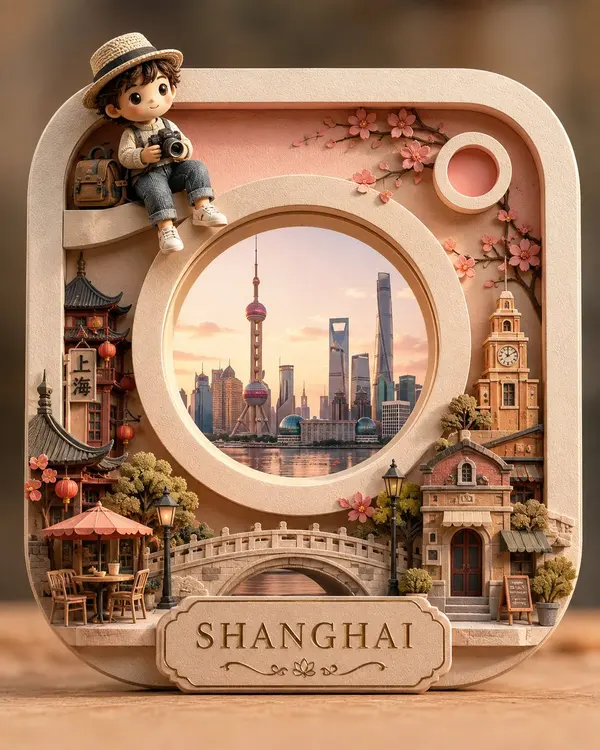
Create a premium 3D paper-cut diorama inspired by the Instagram logo, using the iconic rounded-square frame and central circular lens as the defining structural elements. The composition should represent {CITY} through a simplified, elegant miniature scene featuring only 3–6 of the city’s most recognizable landmarks, architectural icons, and cultural elements. Avoid a dense cityscape. Arrange every element harmoniously with generous negative space, refined proportions, and a clean, sophisticated visual hierarchy.
CENTRAL CIRCULAR OPENING:
Inside the central circular opening, create a simplified scenic view of {CITY}—such as a distant skyline, coastline, mountain range, temple, bridge, monument, or iconic natural landscape. Keep the scene atmospheric and visually restrained, using soft perspective and subtle depth rather than excessive architectural detail.
MINIATURE TRAVELER:
Place a cute handcrafted traveler doll sitting naturally on the top-left edge of the Instagram-inspired frame. The traveler wears casual travel clothing, a woven hat, and holds a small camera, with a compact backpack resting beside them. The character should look like a premium knitted or clay miniature toy, featuring expressive eyes, charming proportions, tactile handcrafted textures, and subtle imperfections that reinforce the handmade aesthetic.
LOCAL DETAILS:
Add a restrained selection of small local elements around the landmarks—such as flowering trees, charming cafés, lanterns, cobblestone paths, vintage street lamps, landscaped gardens, regional vegetation, or subtle seasonal details. Keep these elements sparse and intentional so the composition remains minimal, balanced, and uncluttered.
BOTTOM PLAQUE:
At the bottom of the composition, include an elegant engraved plaque displaying "{CITY}" in refined serif lettering, accompanied by delicate decorative flourishes. The plaque should feel physically integrated into the paper sculpture, as though crafted from premium embossed cardstock or a miniature engraved material.
COLOR PALETTE:
Use a warm, sophisticated pastel palette consisting of cream, ivory, blush pink, peach, dusty rose, coral, terracotta, muted lavender, warm beige, soft taupe, honey brown, muted olive, sage green, and gentle slate gray. Avoid highly saturated, fluorescent, or neon colors. Use smooth tonal transitions, subtle gradients, and harmonious color relationships throughout.
LIGHTING & MATERIALS:
Soft warm ambient lighting with a subtle golden-hour glow. Realistic layered cardstock and premium paper textures, delicate shadows between individual layers, refined paper fibers, softly rounded edges, precise miniature architecture, subtle embossing, tactile handcrafted surfaces, realistic material separation, shallow depth of field, and gentle atmospheric falloff. The final result should feel like an exclusive luxury travel souvenir or collectible handcrafted paper sculpture.
COMPOSITION & STYLE:
Elegant, clean, simplified, uncluttered, premium collectible design, luxury travel keepsake, centered symmetrical composition, carefully balanced negative space, sophisticated miniature scale, high-quality 3D paper sculpture, photorealistic render, physically believable paper construction, Octane-quality rendering, ultra-detailed, 8K, Instagram-inspired visual identity.
STRICT CONSTRAINTS:
No dense cityscape, no excessive landmarks, no visual clutter, no extra text beyond "{CITY}", no watermarks, no logos other than the Instagram-inspired structural frame, and no people other than the single miniature traveler. Preserve the rounded-square Instagram-inspired frame and central circular opening as core elements. Aspect ratio: 4:5.
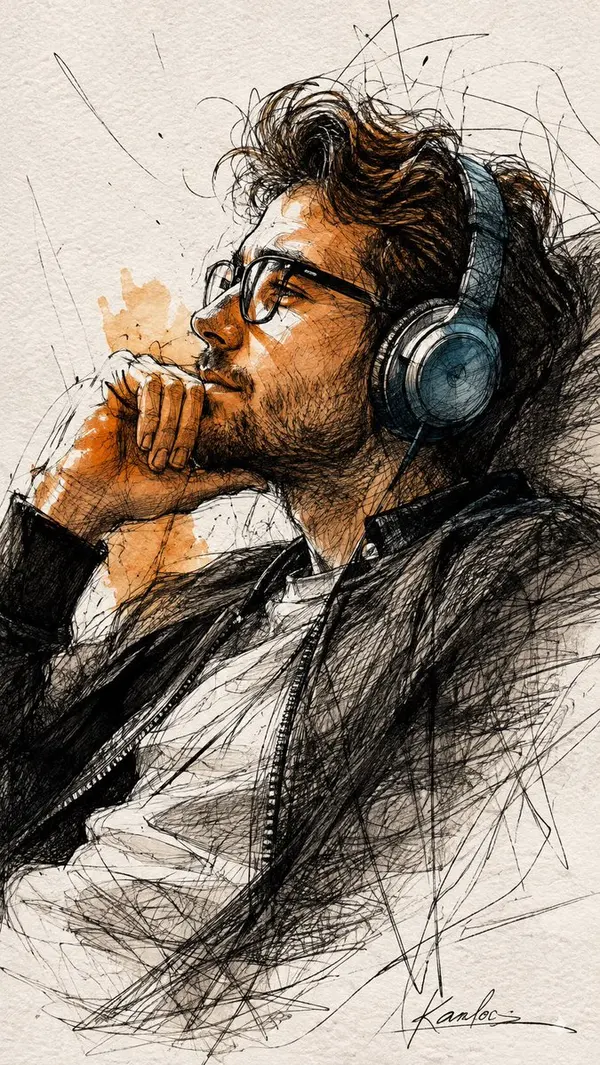
Expressive ink sketch portrait of a contemplative man (image Uploaded), in profile reclining with headphones, chin resting on his hand, made with loose gestural pen strokes and frenetic cross-hatching, energetic scribbles and overlapping lines suggesting motion and thoughtful stillness, warm orange watercolor washes on the face and hand for dramatic highlights, a cool blue accent on the headphone, high-contrast black ink, textured cold-press paper grain visible, minimalist negative-space background, cinematic side lighting, raw spontaneous illustrative style, fine-detail linework with splashes of color, artistic signature at the bottom, moody, intimate atmosphere
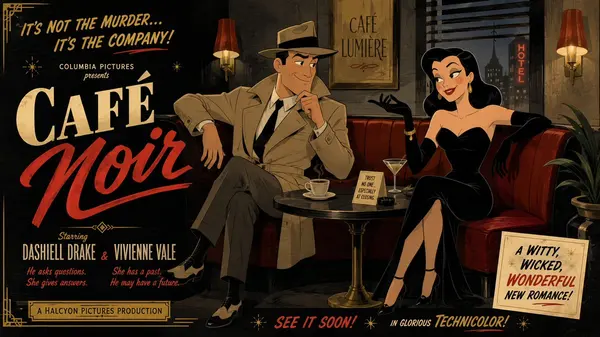
Mid-century theatrical cartoon still promotional Hollywood movie trailer banner featuring a cool detective with neatly combed black hair and a raised eyebrow, wearing a classic trench coat and fedora, and a mysterious femme fatale with sleek dark waves and a knowing smile, wearing a form-fitting black evening dress and long gloves, seated in a dimly lit café booth. Stage them in a lighthearted, intriguing, good-humored interaction, with both characters fully visible, relaxed, and clearly reacting to each other with playful suspicion. Design the figures with exaggerated early-1950s animation caricature: clean black contour lines, sharply simplified anatomy, elegant angular silhouettes, expressive eyebrows, stylized facial shapes, graceful hand gestures, and cheerful readable expressions. Render the entire image in a unified traditional cel-animation aesthetic, with the background following the same stylized visual language as the characters, using flat opaque colors, minimal hard-edged shading, simplified furniture and décor, subtle hand-painted texture, controlled perspective, and crisp theatrical staging. Use a classic noir palette of deep charcoal, soft red, cream, and muted gold and maintain a witty, charming, visually snappy mood.
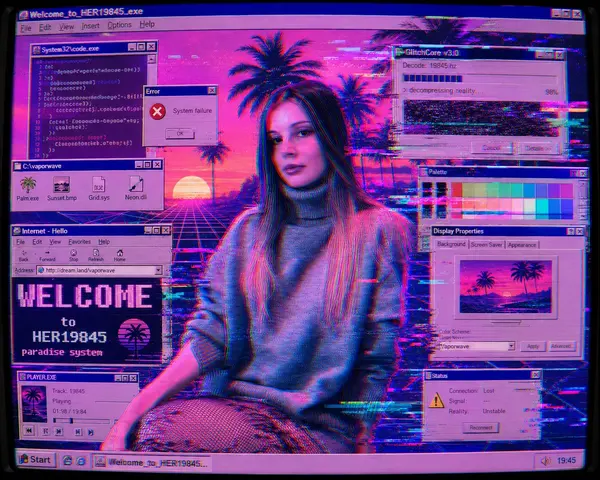
A highly complex digital glitch art illustration capturing a vaporwave scene. In the center is the attached model. Behind her is a tropical beach landscape with palm trees at sunset, all rendered with a wireframe-style neon perspective grid extending to the horizon. Numerous old desktop GUI windows (Windows 98 style) are superimposed in the foreground and background, filled with unreadable code and outdated icons.
The image should be saturated with intense distortion effects:
1. **Severe chromatic aberration** separating the cyan, magenta, and yellow color channels.
2. **Digital glitch stripes and scanline displacement** breaking the palm trees and windows into blocks of data, especially on the right.
3. **Image compression artifacts** and visible digital noise in the text and icons.
4. **Acid neon color palette** (cyan, magenta, pink, violet) predominating throughout the composition. The lighting should be ambient neon, projecting cyan and magenta reflections onto the figure and the floor. The composition is cluttered and chaotic, mimicking a malfunctioning computer system. Screenshot of a distorted analog CRT monitor.
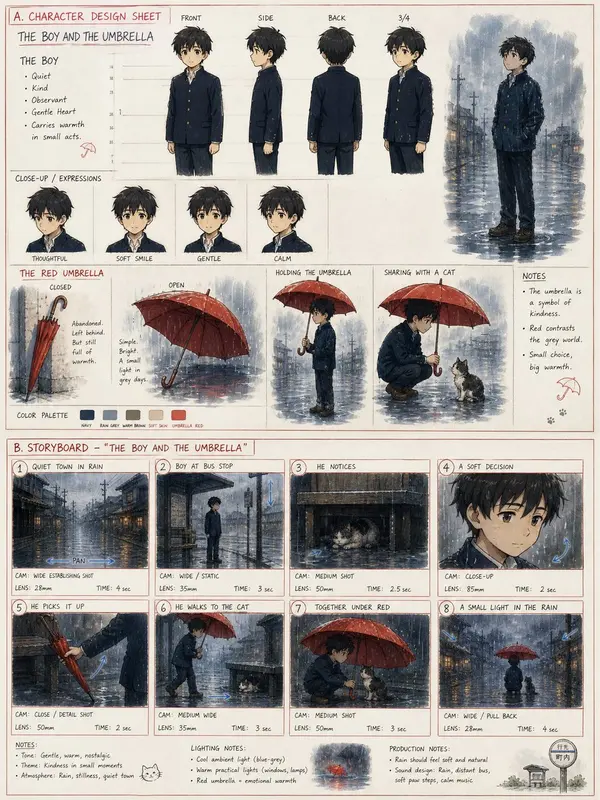
Create a single vertical anime animation development board for an original emotional short film titled "The Boy and the Umbrella".
The output must be ONE combined image containing an anime character design sheet and a cinematic storyboard page.
IMPORTANT:
→ Create fully original anime characters
→ Do not imitate any existing anime studio style directly
→ Do not resemble any copyrighted anime characters
→ Keep designs unique, soft, nostalgic, and emotionally warm
STYLE:
→ Premium anime pre-production board
→ Mix loose hand-drawn storyboard sketches with semi-rendered anime keyframes
→ Use soft watercolor-style lighting, cool blue-grey rain colors with warm red umbrella accent, gentle shadows, red storyboard borders, blue motion arrows, handwritten production notes, timing notes, and lens notes
LAYOUT:
Clean vertical composition with 2 sections.
SECTION A — CHARACTER DESIGN SHEET
Boy:
→ A quiet anime boy with neat dark hair, gentle brown eyes, soft round features, and a calm thoughtful expression
→ He wears: a simple dark navy school jacket, dark trousers, white shirt, worn brown shoes
→ He should feel: kind, quietly lonely, gently warm, emotionally soft
→ Show: front view, side profile, back view, 3/4 angle
→ Expressions: thoughtful, soft smile, gentle, calm
→ Pose standing alone in the rain without an umbrella
→ Pose holding the red umbrella gently
→ Pose sharing the umbrella with a small cat
Red Umbrella:
→ A simple classic red umbrella — bright, warm, emotionally vivid against the cool rainy background
→ It should feel: warm, comforting, a small act of kindness, emotionally significant
→ Show: closed leaning on wall, open in the rain, shared over boy and cat
Add tiny handwritten notes and soft pastel anime color swatches.
SECTION B — STORYBOARD
Create 8 cinematic anime storyboard panels in a neat grid. Each panel should include handwritten camera notes, blue motion arrows, timing notes, and lens notes.
Story Beats:
→ Wide shot of a quiet old anime town in gentle rain — grey sky, wet stone streets, warm glowing windows
→ The boy stands alone at a bus stop in the rain, no umbrella, quietly watching the rain fall
→ He notices a small cat huddled soaking under a bench nearby
→ Close-up of his face — a soft gentle decision forms in his expression
→ He picks up an abandoned red umbrella from the side of the bench
→ He walks to the cat and holds the umbrella over both of them
→ Medium shot — boy and cat under the red umbrella, rain falling around them, warm and still
→ Emotional ending — the boy and cat under the single red umbrella, the whole grey town soft around them
Environment:
Old anime town on a rainy afternoon. Wet stone streets, warm glowing shop windows, old wooden buildings, puddles reflecting light. Cool blue-grey rain with one warm red accent.
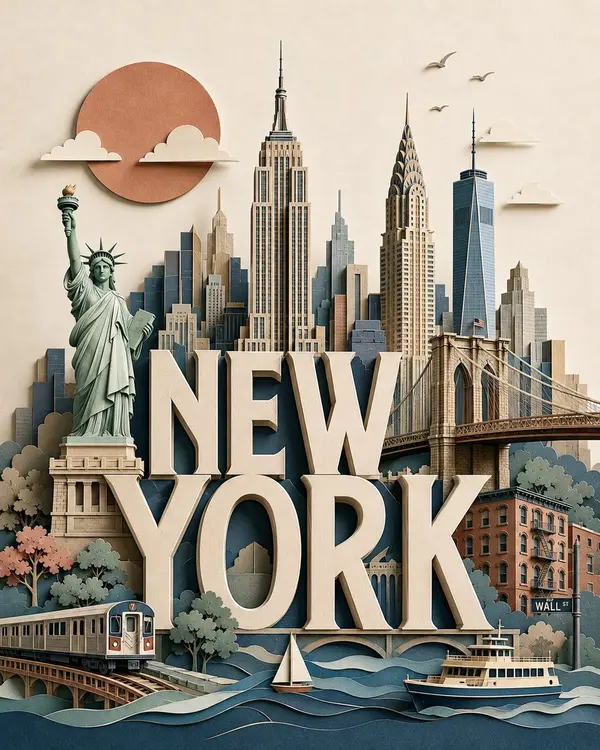
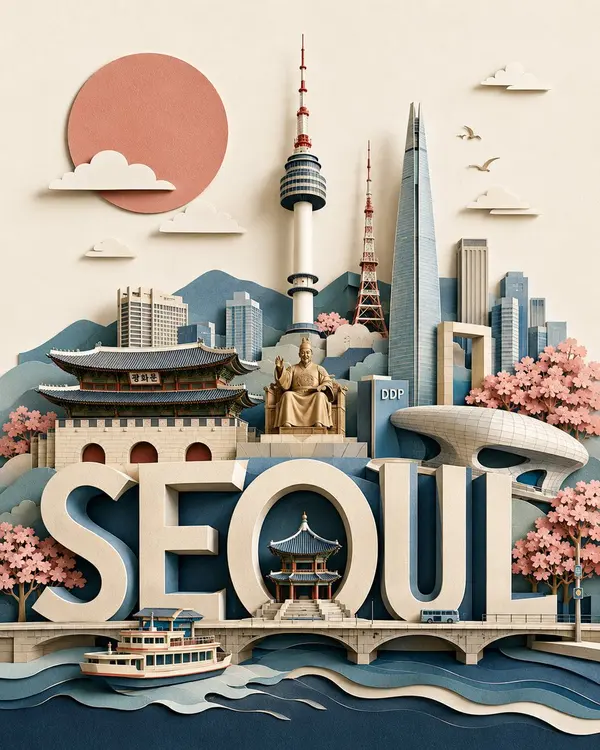
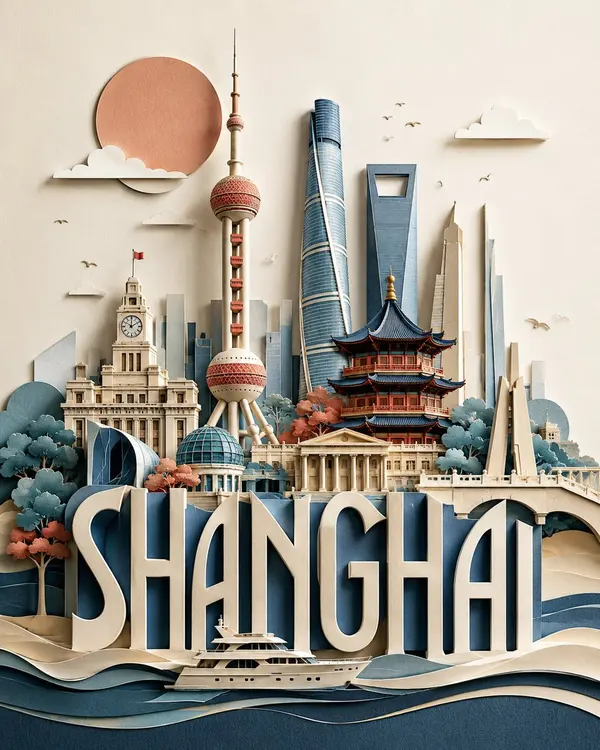
Create a premium 4:5 vertical travel-art poster for [CITY NAME], inspired by the reference images. Use a refined handcrafted paper-cut / layered 3D architectural illustration style with clean editorial composition and subtle dimensional depth.
CORE CONCEPT:
Create a stylized miniature world of [CITY NAME] using its most recognizable real landmarks, architecture, monuments, streets, bridges, waterways, and cultural details. Keep landmarks recognizable while translating them into elegant layered paper sculptures.
CITY NAME INTEGRATION:
Embed the exact text “[CITY NAME]” naturally into the artwork as a major graphic element. Make the typography physically integrated into the paper-cut environment rather than a separate caption. Use elegant architectural typography that complements the landmarks. Keep it clearly readable, correctly spelled, and balanced within the composition.
VISUAL STYLE:
• Handcrafted paper-cut illustration
• Layered cardstock / sculpted paper
• Subtle 3D depth
• Clean geometric silhouettes
• Soft bevels and realistic paper edges
• Delicate cast shadows
• Sophisticated editorial travel-poster aesthetic
• Stylized yet architecturally accurate landmarks
• No photorealistic rendering
COMPOSITION:
Create a spacious vertical composition with generous upper negative space. Feature 2–4 iconic landmarks of [CITY NAME] as the main focus, arranged at different depths and scales.
Add atmospheric paper-cut elements where appropriate:
• Circular sun/moon
• Minimal sculpted clouds
• Layered trees and foliage
• Bridges, streets, plazas, or waterfronts
• A recognizable local vehicle or boat
• Subtle distant city silhouettes
Use layered geometric ground surfaces, roads, plaza patterns, or flowing paper-cut water shapes in the foreground to create depth and visual rhythm.
COLOR PALETTE:
Use a restrained palette inspired by the references: warm ivory/off-white, dusty blue, deep navy, soft teal, terracotta, warm beige, muted gold, plus subtle accents reflecting [CITY NAME].
Keep colors cohesive and slightly desaturated.
LIGHTING & DEPTH:
Soft studio illumination from the upper left with delicate shadows beneath each paper layer. Add subtle ambient occlusion, dimensional edges, gentle highlights, and tactile cardstock texture. Make it feel like a professionally crafted miniature paper diorama photographed against a clean studio background.
ARCHITECTURAL ACCURACY:
Use real, recognizable landmarks from [CITY NAME]. Preserve their distinctive silhouettes, domes, towers, columns, façades, statues, bridges, and architectural proportions while translating them into the simplified paper-cut style.
IMPORTANT:
The artwork must immediately communicate “[CITY NAME]” through both its architecture and integrated typography. The city name should feel like a natural part of the physical poster design.
OUTPUT:
Premium 4:5 vertical travel poster, balanced composition, elegant negative space, tactile layered-paper construction, integrated typography, crisp details, polished editorial design, high-end collectible travel-art aesthetic.
AVOID: Photorealism, generic or inaccurate landmarks, clutter, oversaturation, flat vector graphics, cartoon/anime styling, plastic 3D, distorted architecture, misspelled or illegible text, duplicate elements, excessive text, watermarks, logos, and AI artifacts.
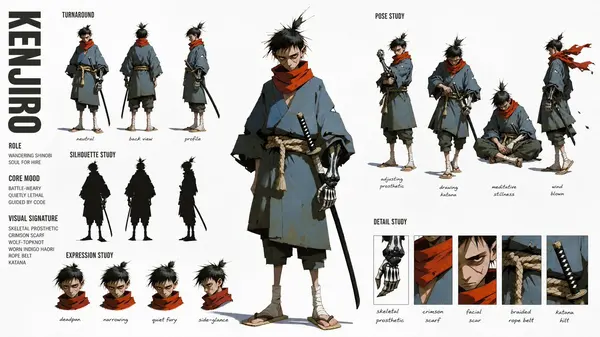
Create a premium, modern high-fashion CHARACTER CONCEPT ART SHEET in a 16:9 widescreen layout on a pure white background.
THE ATTACHED REFERENCE IMAGE DEFINES THE ART STYLE — treat it as a strict style bible and reproduce its exact rendering technique in every figure on this sheet.
[STYLE — MIRROR THE REFERENCE EXACTLY]: Replicate the reference image's rendering verbatim: shapes defined purely by value and color cuts with NO outlines and NO lineart of any kind, hard-edged brush shapes, muted desaturated palette identical to the reference, identical overall brightness and contrast (light, airy, white-background — do NOT darken), soft single-source lighting with shadows as clean flat cut shapes. Every figure — the centerpiece, turnarounds, poses, expression heads, and detail crops — must look like it was painted by the same artist, in the same file, as the reference image.
[STYLE PROHIBITIONS — ABSOLUTE]: no outlines, no ink lines, no graphite lines, no cel-shading, no anime style, no 3D render look, no soft volumetric shading, no glossy highlights, no ambient occlusion, no added contrast, no darkened or moody color grading, no photorealism. If the reference lacks a feature, this sheet lacks it too. Render small figures as if cropped from a larger painting, never as simplified icons.
[PROPORTIONS]: Match the reference's exact body proportions in every figure — elongated fashion-illustration anatomy (10 heads tall, small head, long slender limbs, narrow waist). Do not normalize proportions in the smaller studies.
[SUBJECT_DESCRIPTION]: Young battle-weary shinobi-samurai, facial scar, messy wolf-like topknot. Left arm is a skeletal prosthetic made of dark-iron and bone. Outfit: massive oversized asymmetrical faded-indigo haori coat, thick rope belt, skinny ash-gray pants, bandage-wrapped ankles, straw sandals. Accessories: vibrant crimson tattered scarf, sleek katana.
Layout Composition (Organize strictly into these sections):
1. LEFT PANEL: METADATA & TURNAROUND- Large, bold vertical typography of the name "KENJIRO" in a clean, heavy sans-serif condensed font.- Metadata Block: "ROLE", "CORE MOOD", and "VISUAL SIGNATURE" in a clean sans-serif font.- MINI TURNAROUND: 3 small vertical figures — "neutral", "back view", "profile" — painted in the identical reference style, no outlines.- SILHOUETTE STUDY: 3 solid-black silhouettes matching the turnaround stances underneath.- EXPRESSION STUDY (Bottom Left): exactly 4 small close-up headshots with subtle expression shifts (deadpan, narrowing eyes, quiet fury, side-glance).
2. CENTRAL PANEL: THE CENTERPIECE- One giant, dominant full-body figure in a lethal, relaxed signature pose resting his hand on his katana, maximum detail, rendered as a perfect style-match to the reference image.
3. RIGHT PANEL: MULTI-POSE & THEMATIC STUDIES- POSE STUDY: exactly 4 small-to-medium figures in dynamic casual stances (adjusting prosthetic arm, drawing katana, sitting cross-legged, wind blowing scarf), each with a small handwritten-style label underneath, all in the identical reference style.
4. BOTTOM RIGHT PANEL: DETAIL STUDY- Exactly 5 small square close-up crops of unique features: the dark-iron prosthetic hand, the crimson tattered scarf, the facial scar, the braided rope belt, and the katana hilt.- Each crop gets a clean handwriting-style label underneath.
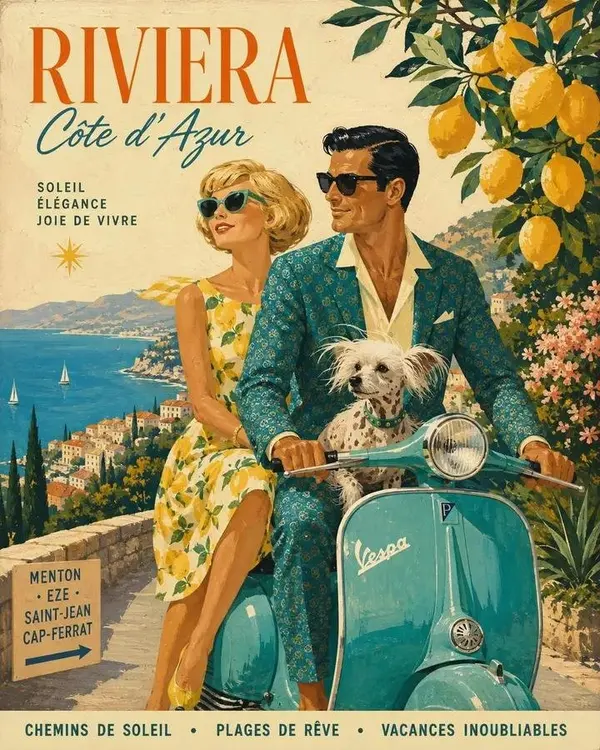
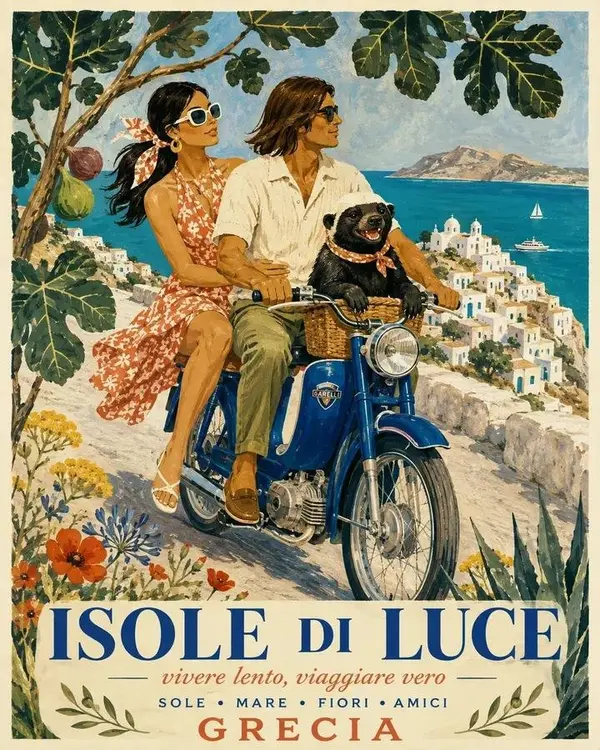
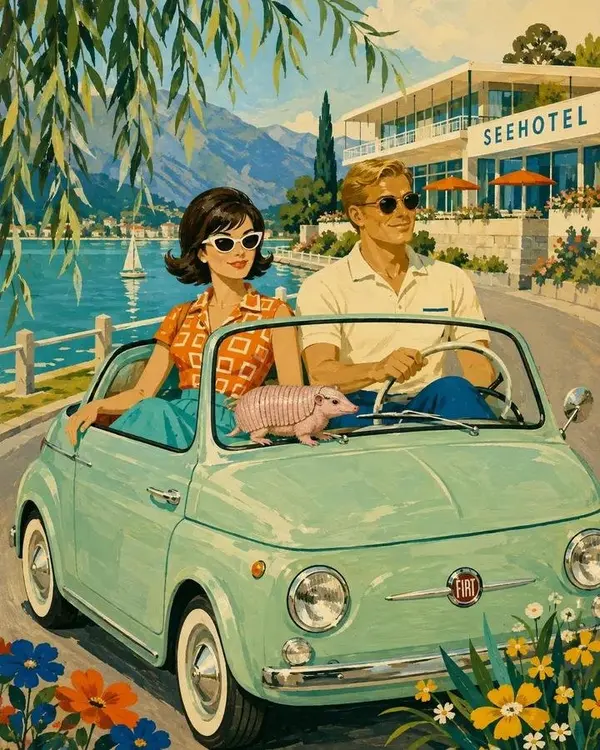
Mid-century travel-ad illustration featuring [HUMANS] riding [VEHICLE], accompanied by [ANIMAL]. Dress them in [CLOTHING] using [PALETTE]. Place the scene in [SCENERY], with lush stylized foliage framing the figures and vehicle. Render with flat gouache-like color shapes, visible dry-brush strokes, simplified facial features, crisp graphic silhouettes, hand-painted texture, decorative botanical forms, and warm sunlit color harmony.
Use the uploaded reference image as the ONLY facial identity reference.
Preserve the exact same person with maximum fidelity. Maintain the identical facial identity, facial structure, skull shape, jawline, cheekbones, forehead, ears, eyes, eyebrows, eyelids, nose shape, nostrils, lips, mouth, chin, skin tone, hairstyle, hairline, facial proportions, glasses, age, expression, ethnicity, and overall recognizable appearance.
Do NOT redesign, beautify, idealize, de-age, age-shift, alter ethnicity, modify facial proportions, change the hairstyle, replace the glasses, reinterpret facial features, or create a different person.
Identity preservation overrides every artistic, stylistic, lighting, wardrobe, composition, rendering, and color instruction below.
Keep the face instantly recognizable as the exact same person from the uploaded image.
---
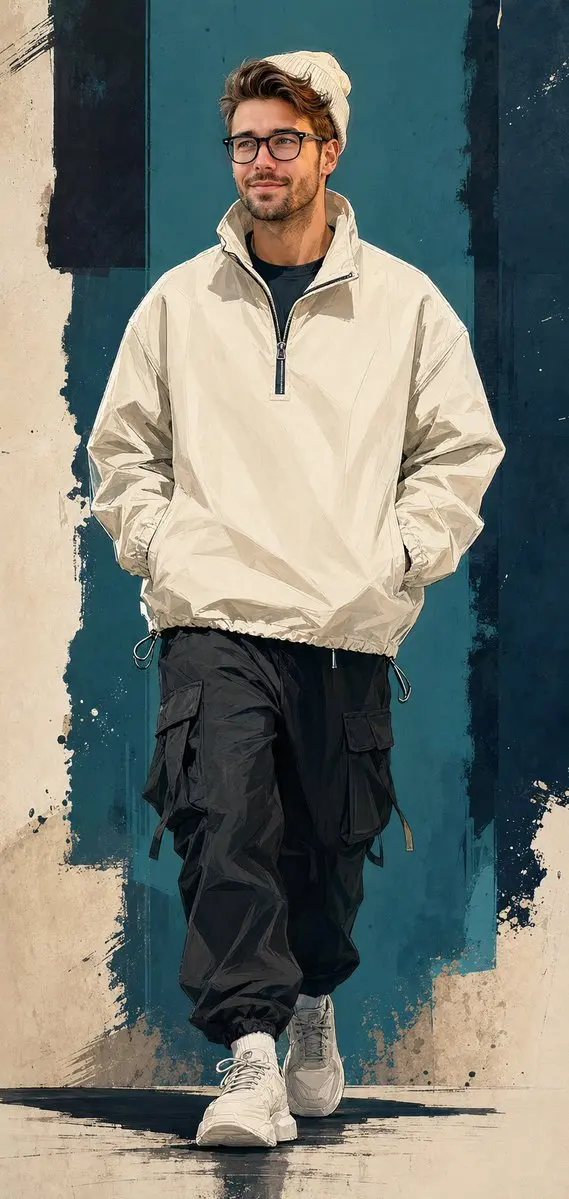
Transform the uploaded person into a semi-realistic digital illustration streetwear campaign poster.
The person keeps the exact same face, hairstyle, glasses, facial proportions, skin tone and identity as the uploaded photo.
Outfit:
- cream ribbed knit beanie
- oversized cream technical windbreaker quarter-zip jacket
- funnel collar
- drawstring hem
- black t-shirt underneath
- black oversized cargo joggers with multiple flap pockets and hanging drawstrings
- white chunky sneakers
Pose:
Walking mid-stride,
hands inside jacket pockets,
head naturally turned and gazing off-camera,
confident expression.
Art Style:
Semi-realistic digital illustration
Comic-editorial hybrid rendering
Clean vector linework combined with painterly color fills
High-end streetwear campaign artwork
Fashion editorial poster aesthetic
Modern urban illustration
Premium graphic design
Background:
Abstract graffiti-inspired composition
Deep teal and dark navy color-block panels
Distressed paint textures
Rough torn-paper transitions
Brushstroke overlays
Urban graphic shapes
Minimal abstract environment
Lighting:
Soft directional studio lighting from upper left
Subtle rim lighting
Natural shadows
Cinematic contrast
Color palette:
Cream
Deep teal
Dark navy
Black
Off-white
Muted neutral tones
Composition:
Vertical poster
Full-body
Walking toward camera
Centered composition
Clean negative space
No text
No logo
No typography
No watermark
No signature
No labels
No symbols
No UI elements
Ultra detailed
Masterpiece
Best Quality
Professional fashion campaign illustration
Sharp focus
8K