Image Denoiser: Remove Noise from Photos Without Killing the Image
 Claire Dubois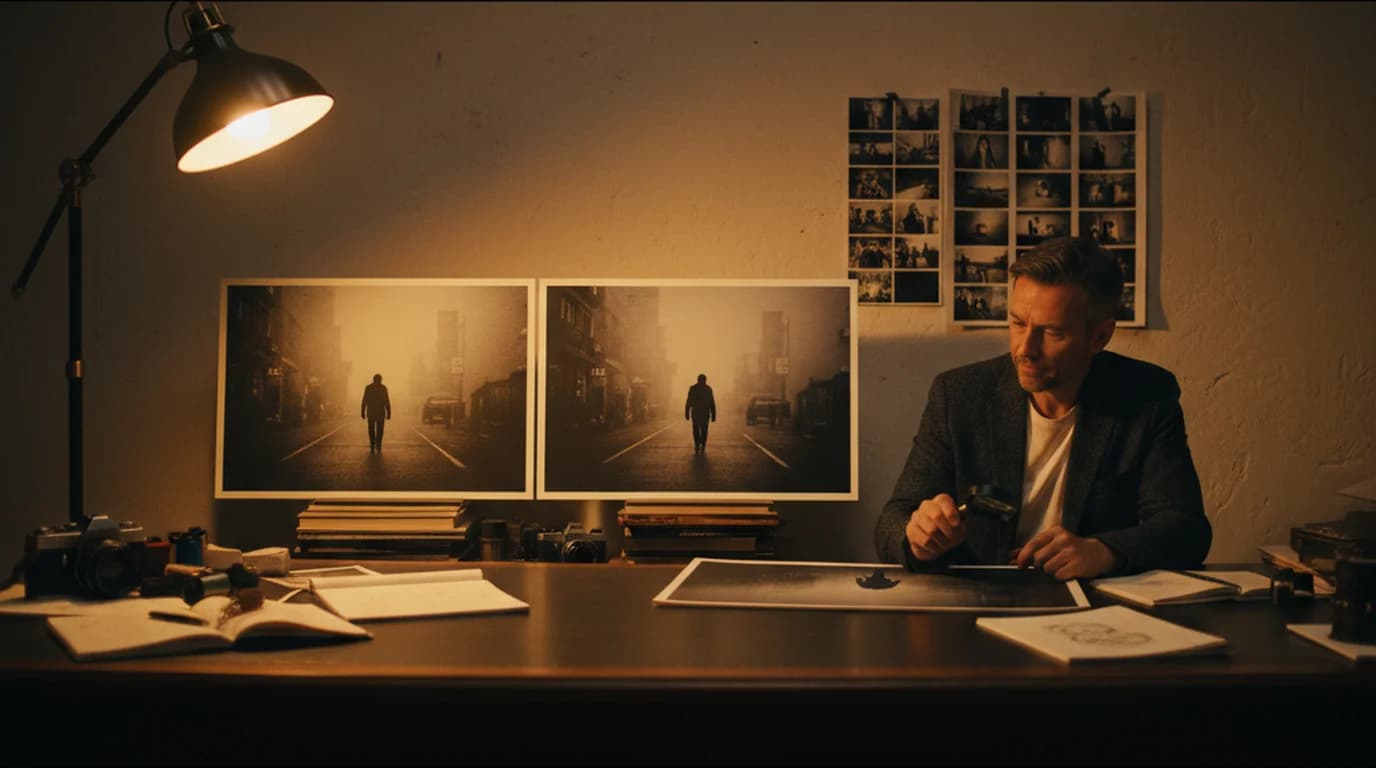
Not all noise is a problem. Some of the most resonant fashion and lifestyle campaign images are shot on 35mm specifically for the grain — that visible texture is part of what makes the image feel lived-in, tactile, not surgically digital.
But that's a choice. What this piece addresses is the other kind: the involuntary, technically damaging noise that appears when your photographer shoots indoors at ISO 3200, when a supplier sends product images lifted from a poorly lit showroom, when you're trying to recover a shot from an event you can't reshoot. That noise isn't texture — it's interference. And there's now a category of AI image denoiser tools that removes it well.
Direct answer. An image denoiser removes ISO grain, sensor noise, and JPEG compression artefacts from photographs by identifying the statistical signature of noise — random, uncorrelated between pixels — and separating it from real edge-aligned image detail. AI-based denoising preserves sharpness where blur-based tools flatten everything. The practical result is a cleaner image that still reads as sharp, not a softer image with less grain.
What Makes a Photo "Noisy" — and Why It Matters for Brand Work
Image noise is the random variation in pixel values that doesn't correspond to anything in the scene. It looks different depending on its source:
ISO noise appears at high sensitivity settings — the grain is multi-coloured (red, green, and blue speckle rather than uniform grey), scattered across the frame, and proportionally stronger in shadow areas and smooth backgrounds. It's what you see when you crop a phone photo taken indoors at arm's length.
Sensor noise is the electronic baseline — the amount of random signal your camera produces even in complete darkness. Professional bodies keep this extremely low; consumer cameras less so. In long exposures, sensor heat adds thermal noise on top.
JPEG compression artefacts are structurally different — they're not random but patterned, appearing as blocky regions in smooth areas and as ringing along high-contrast edges. They accumulate when an image is saved as JPEG at high compression ratios or repeatedly resaved.
For brand work, noise matters because it reads as low quality. A product image with visible grain looks like it was photographed under poor conditions. A portrait with heavy noise undermines the precision and care a luxury brand requires. The image communicates something about production values before a viewer has read a word.
The Difference Between Film Grain and Digital Noise
This distinction shapes every decision when reviewing images from a shoot.
Film grain is physical — the random arrangement of silver halide crystals in photographic emulsion. It's luminance-based (grey, not coloured), structurally consistent across the frame, and has a texture that reads as organic. When you shoot 35mm and scan it, the grain is part of what you're getting. For lifestyle, youth, and heritage brands, that texture can be the whole point.
Digital noise is electronic. It's colour-shifted (red, green, blue speckle rather than grey grain), varies in intensity across the frame (shadows noisier than highlights), and has no structural consistency — it's genuinely random. It doesn't carry the aesthetic weight of film grain because it doesn't look like anything intentional. It looks like a mistake.
When a brief asks to "add grain" to a digital image for that film feel, what's actually required is synthetic film grain — a structured, luminance-based texture that mimics what 35mm produces. That's quite different from leaving digital noise in. One is an aesthetic choice. The other is a technical failure that most viewers clock, even if they can't name it.
Why Traditional Noise Reduction Destroys Detail
Classic noise reduction — Gaussian blur, median filters, a heavily pushed luminance-smoothing slider — works by averaging pixel values across a neighbourhood. Noise disappears because it's random; when you average random values, they cancel out. But real detail — the edge between a jaw and a background, the fine weave of a fabric, the text on a product label — also gets averaged.
The practical result is an image where the grain is gone but the sharpness has followed it. Portraits where luminance smoothing has been over-applied look like they were photographed through a soft filter — technically clean, but devoid of the crispness that makes a face look real. Product labels are unreadable. Fabric texture is gone.
The problem is architectural: blur-based tools can't distinguish between noise and detail because they don't have a model of what either looks like. They smooth everything.
How AI Denoising Preserves What Matters
AI-based image denoising uses a different approach. The model is trained on pairs of noisy and clean images and learns the statistical signature of noise across different image types, ISO levels, and sensor characteristics. It learns what noise looks like and what real detail looks like — and they're statistically different.
Noise is random and spatially uncorrelated: the value of a noisy pixel tells you nothing about the value of its neighbour. Real detail is structured and edge-aligned: there are patterns, gradients, and transitions that the model learns to recognise and preserve.
That's the goal when you run a portrait through an AI image denoiser: skin that reads as clean without looking smoothed, with the fine pores and texture that make a face look three-dimensional still there. The background noise should be gone, and at 100% zoom the jawline should still be sharp. That's the difference between AI denoising and blur.
When to Remove Image Noise — and When to Leave It
The test: does the noise serve the story?
Remove it when:
- The noise is digital (colour-shifted, random, structurally inconsistent)
- The image is product photography, architectural photography, or any context where precision reads as quality
- The noise is concentrated in backgrounds and smooth areas where it's most distracting
- The image needs to be enlarged — noise becomes much more visible at larger sizes
Leave it (or add structure) when:
- The grain is intentional film grain from an actual film shoot
- The aesthetic requires texture — lifestyle, documentary, archival, heritage contexts
- The noise is so pervasive that removing it would fundamentally change the image's character
- The client has specifically asked for that texture as part of the brief
The campaign images that feel the most artistically coherent are usually the ones where every element — including grain — was a decision. A deliberately grainy lifestyle campaign and a clinically clean product shoot can both be right. The failure mode is noise that's there by accident.
How to Remove Noise from Photos Online
For the practical workflow:
-
Upload your image to Playyy's image denoiser. JPEG, PNG, and WebP are all supported.
-
The AI processes it automatically — no settings to adjust, no sliders to move. The model identifies the noise pattern specific to this image and removes it while preserving edge-aligned detail.
-
Download the result. For most images, the difference is visible at 100% zoom — backgrounds are clean, skin and fabric retain their structure, and JPEG compression blocks are gone.
-
If the image needs to be used at print size, run the denoised version through the image upscaler next. Denoising before upscaling produces better upscaling results — the model has cleaner input data to work with, and the upscaled output holds more coherent detail.
For retouchers working on portrait or editorial work: AI denoising is a first pass, not a replacement for skin retouching. It removes the noise layer, which makes the subsequent manual retouch more precise — you're working with the real texture of the skin, not fighting noise on top of it.

Claire Dubois
I advise fashion, beauty, lifestyle and hospitality brands on campaign direction, brand storytelling and visual consistency. I care deeply about how brands use AI tools while preserving taste, restraint and a coherent art direction.
Frequently asked questions
An image denoiser is a tool that removes random pixel-level variation — ISO grain, sensor noise, JPEG compression artefacts — from a photograph. AI-based image denoisers distinguish between noise (statistically random, uncorrelated between pixels) and real detail (structured, edge-aligned) and remove only the noise, leaving edges, texture, and fine detail intact.