Design Arena: Which AI Makes the Best Presentations
 Daniel Brooks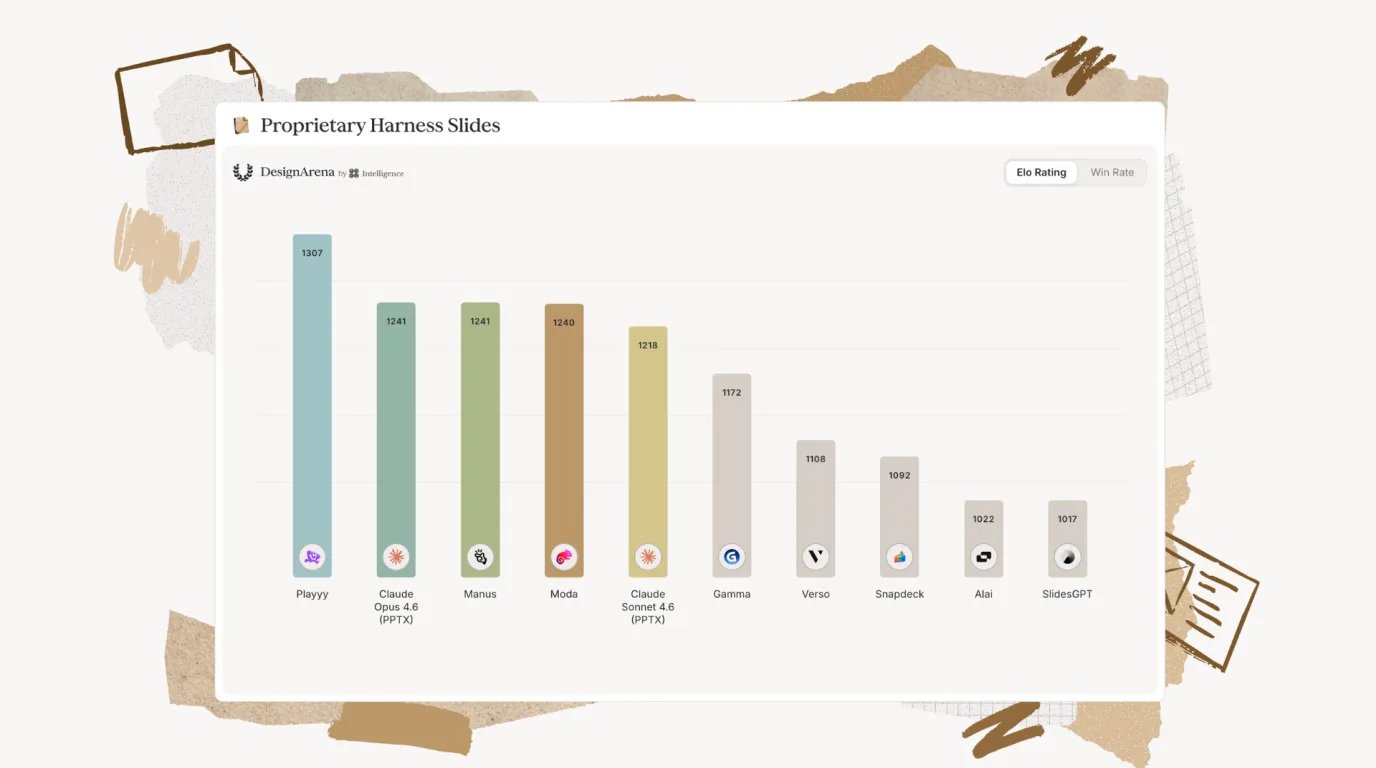
Most "best AI presentation tool" articles are one person's opinion with an affiliate link attached. Design Arena is the closest thing the category has to an actual measurement, and the results are more interesting than the marketing from any single vendor.
Direct answer. Design Arena is a crowdsourced benchmark that shows people two AI-generated designs side by side and asks which is better, converting millions of those pairwise votes into Elo ratings per category. On its slides leaderboard as of August 2026, Playyy holds the top rating in the general purpose, marketing, and educational categories.
How the Benchmark Works
The mechanism is deliberately simple. You are shown two designs generated from the same prompt, with the tools that made them hidden. You pick the better one. That vote adjusts both tools' ratings using the Bradley-Terry model, reported as an Elo score, the same maths chess ratings use.
Because opponents are hidden and ratings are relative, beating a strong tool moves you further than beating a weak one. And because votes accumulate continuously rather than being frozen at publication, the leaderboard is a live measurement rather than an annual roundup.
Design Arena covers many categories: websites, logos, mobile apps, data visualisation, 3D, and slides among them. Its parent company, Intelligence, raised a $7.9 million seed round led by Index Ventures in August 2026, with participation from Conviction, A*, and Valkyrie. The platform draws on roughly 5.3 million people, and the labs building frontier models use that preference data to teach their systems what looks good, a problem automated scoring has never solved well.
Design Arena converts pairwise human preference votes into Bradley-Terry Elo ratings per design category, updating continuously rather than on an editorial cycle. That structure makes it useful for a question feature comparisons cannot answer: given the same brief, whose output do people actually prefer?
The Slides Leaderboard, August 2026
Here is the overall slides category, with battle counts included because they matter for how much weight each rating deserves.
| Rank | Tool | Elo | Battles |
|---|---|---|---|
| 1 | Playyy | 1307 | 364 |
| 2 | Claude PPTX (Opus) | 1241 | 761 |
| 3 | Manus | 1241 | 3,222 |
| 4 | Honeydew | 1240 | 3,421 |
| 5 | Claude PPTX (Sonnet) | 1218 | 2,876 |
| 6 | Gamma | 1172 | 5,137 |
| 7 | Verso | 1108 | 295 |
| 8 | Snapdeck | 1092 | 1,580 |
| 9 | Alai | 1022 | 579 |
| 10 | SlidesGPT | 1017 | 783 |
Two things stand out. First, the top five are separated by under 90 Elo points, close enough that for most briefs, several of these tools produce comparable work. Second, Gamma sits sixth despite having more recorded battles than any other entrant. Brand recognition and human preference on a specific output are clearly different things.
Where the Categories Diverge
The overall table hides the more useful detail. Design Arena splits slides into subcategories, and the ordering changes between them.
General purpose: Playyy 1309, Manus 1247, Honeydew 1225, Claude PPTX Opus 1209, Gamma 1184, Claude PPTX Sonnet 1183, Snapdeck 1110, SlidesGPT 927.
Marketing: Playyy 1302, Honeydew 1288, Manus 1282, Claude PPTX Sonnet 1243, Claude PPTX Opus 1221, Gamma 1136, Snapdeck 1026, Alai 972, SlidesGPT 926.
Educational: Playyy 1309, Claude PPTX Opus 1265, Manus 1256, Claude PPTX Sonnet 1245, Honeydew 1240, Gamma 1178, Verso 1099, Snapdeck 1090, SlidesGPT 1042, Alai 1026.
Marketing is the tightest race. The top three sit within 20 points, which is well inside the range where a different set of prompts could reorder them. Educational is the widest, where the gap between first and sixth is over 130 points.
The general agents perform better than you might expect. Manus and Claude's PPTX models place top four in every category despite not being presentation products, which suggests that for slides, the quality of the underlying model matters more than the specialisation of the interface, up to a point.
Reading This Honestly
Playyy leads all three categories, and since this is published on Playyy's own site, the numbers behind that lead should be visible rather than buried.
Playyy's ratings rest on fewer battles than the incumbents: 58 in general purpose, 52 in marketing, and 167 in educational, against Gamma's 439, 662, and 2,860. That gap is a function of arrival time rather than performance. Playyy entered the arena considerably later than Gamma, Manus, and Honeydew, and battle counts accumulate from the day a tool joins. Gamma has been collecting votes for far longer, which is also why it holds the highest battle count in the category despite its sixth-place rating.
What the gap does mean is statistical: a rating built on 52 votes carries a wider confidence interval than one built on 662, so the exact Elo figures will move more for newer entrants as votes accumulate. The direction is the more meaningful signal here. Leading all three categories simultaneously is considerably harder to achieve by chance than winning one.
There are limits that apply to every entrant equally. Voters judge one output from one prompt, so the benchmark measures first-impression appeal rather than how a tool behaves when you need to change a headline at 11pm. It says nothing about editability, whether you can share a live link, export fidelity, pricing, or whether the deck survives contact with your brand guidelines. Those are the criteria that decide which tool a team actually keeps.
The right way to use this leaderboard is as a filter, not a decision. It tells you which tools clear a quality bar on first output. Which one you standardise on still depends on what happens after generation.
What Actually Separates Slide Tools After Generation
Every tool in the top ten produces a reasonable first draft. The divergence starts on the first edit.
In our own testing across launch and campaign decks, three checks sort these products faster than any benchmark: replace one image with your own product photo, change a headline and see whether the layout reflows sensibly, and restyle the whole deck to a different palette in one action. Some tools hold every element as a selectable object throughout. Others return what is effectively a picture of a slide, where the only real edit is regenerating it. A related split: some tools share a live link the way Canva and Pitch do; others only hand you a file to attach.
That difference does not appear in an Elo rating, because voters never touch the output. It is the single biggest predictor of whether a tool saves you time over a month rather than over one afternoon.
Try the Comparison Yourself
Design Arena is public and free to vote on, and running a few rounds yourself is more informative than reading anyone's summary, including this one. You will see the same brief rendered by different systems, and you will form a fairly quick opinion about which house styles you like.
If you want to test the top-ranked entrant on your own material rather than a benchmark prompt, Playyy's presentation maker starts from a product photo, a brief, or a brand kit, keeps every element editable afterwards, and shares as a live link the same way Canva or Pitch would. For how that fits a launch or campaign workflow, see the AI presentation use case. And for tool-by-tool comparisons in the same space, our Gamma alternatives and Manus alternatives breakdowns cover what the leaderboard cannot: what each one is like to live with.
Ratings quoted here were read from Design Arena's public leaderboard in August 2026 and update continuously. Check the current standings before treating any number above as still accurate.

Daniel Brooks
I work with SaaS founders, indie makers and early-stage teams on positioning, launch assets, pitch visuals and founder-led content. I write for small teams making smart decisions with limited time and resources.
Frequently asked questions
Design Arena is a crowdsourced benchmark that shows people two AI-generated designs side by side and asks which is better. Those pairwise votes are converted into Elo ratings per category: slides, websites, logos, and others. It is run by Intelligence, which raised a $7.9 million seed round in August 2026.