A Boutique Hotel's Transparent Background Maker Workflow
 Claire Dubois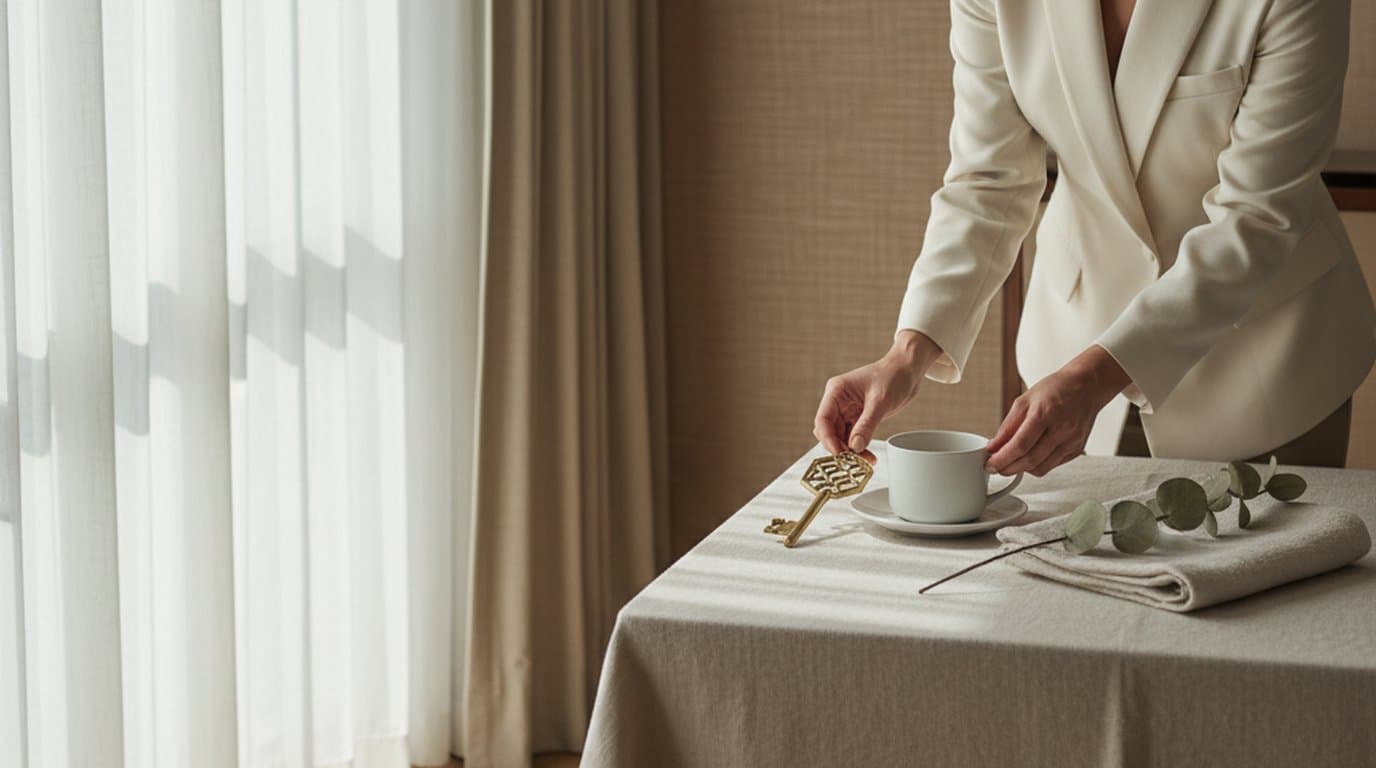
The morning of the autumn campaign briefing, Isabel Ferreira was rearranging a brass room key, a chipped ceramic cup, and a folded square of linen on a marble side table by the window. The light in the suite was thin and grey-pink, exactly the cast she had wanted in last year's photoshoot and exactly the cast the retoucher had spent four days flattening out of every export.
The hotel is a 12-room property in Lisbon's Príncipe Real district, occupying a restored 19th-century townhouse two streets back from the river. Isabel has been brand director since the property opened in 2022, which in practice means she is also its in-house photographer's brief writer, its OTA merchandiser, its Instagram editor, and the only person who has ever opened the email template in Mailchimp.
For three seasons she had outsourced cutout work to a freelance editorial retoucher in Porto at a rate that translated to roughly €4,200 per campaign cycle. This autumn she did not.
A property of twelve rooms cannot photograph its way out of every campaign — but it can edit its way into one. When the same brass key, the same ceramic cup, and the same folded linen need to appear on a website hero, an OTA secondary image, an Instagram carousel, a Pinterest pin, and an email banner, the answer is rarely a new shoot. The answer is a clean cutout and a layered file.
The result. Isabel produced 42 transparent PNG cutouts from a half-day shoot and used Playyy's editable canvas to composite them across five campaign channels in six working days. Retoucher spend fell sharply across the season, and campaign turnaround roughly halved.
Why Hospitality Visual Operations Are Uniquely Fiddly
Hospitality marketing is constrained in a way that DTC product marketing is not. A skincare brand can ship a sample to a studio anywhere. A 12-room hotel cannot ship its lobby. The visual inventory is geographically fixed, seasonally variable, and aesthetically singular — the same suite, the same brass key, the same garden in three different lights.
That constraint shows up in retoucher invoices. According to Skift's 2024 Hospitality Marketing Outlook, independent boutique properties spend disproportionately on visual production relative to their room count because every campaign asset has to be produced from a narrow scene catalogue. Recycling without looking recycled becomes the central craft problem.
Isabel had been tracking the numbers since opening. Photography was the second-largest line in her annual marketing budget, behind paid OTA placement and ahead of email tooling, paid social, and PR combined.
The Launch Upgrade: An Editable Canvas for Cutouts
Until this spring, Playyy's hospitality customers were using the Background Remover and Object Eraser as standalone steps. The new Playyy's AI Image Editor brings those into a single editable canvas — layers, masks, inpaint, outpaint, recolor, text edit, restyle — without leaving the file.
For Isabel, the practical shift was being able to isolate the brass key from its marble tabletop, refine the mask with a brush, drop the cutout onto a deeper terracotta background, and outpaint a longer banner extension — all in one workspace, one export.
Independent properties now produce far more campaign assets per season than they did a few years ago, without matching budget increases. The implication is direct: per-asset cost has to fall for the arithmetic to work at all — which is why the retouching step is the first place to look.
She tested the workflow against the autumn campaign brief, which called for a still life of "the small ceremonies of the house" — the key handed over at check-in, the cup of bica left on the writing desk, the linen turndown — across five channels.
A Six-Step Seasonal Campaign Workflow
The campaign was produced by Isabel and one part-time designer over six working days. The workflow was deliberately linear:
- Shoot once, shoot cleanly. A half-day with the seasonal photographer, six still-life scenes against the marble side table, even window light, no model. Total: 42 raw JPEGs.
- Mask each object. Isabel opened each frame in the AI editor and used the Background Remover to isolate the brass key, the ceramic cup, the linen square, and a single dried protea. Roughly 90 seconds per object.
- Refine edges inside the canvas. Where the brass key cast a sharp shadow on the marble, she brushed the mask manually until the cutout read cleanly against any backdrop. Sheer linen needed partial opacity preserved — the editor kept that.
- Drop onto campaign palettes. Five branded backgrounds — deep terracotta, dusty ochre, slate blue, off-white linen texture, a photographic shot of the property's stairwell — became the canvas. Cutouts layered cleanly on each.
- Inpaint and recolor. A guest robe shot against a beige duvet needed to read against the slate background; Inpaint & Replace corrected a shadow that was reading too cool, and a recolor pass adjusted the linen's warmth.
- Export per channel. Each composite was sized and re-cropped for the channel matrix — 16:9 for the website hero, 1:1 for Instagram, 2:3 for Pinterest, 600px-wide for email, A5 for in-room collateral.
For the design-thinking under this kind of layered campaign, see Building a Visual Brand Strategy That Scales.
Channel Rollout: Five Surfaces, One Asset Library
The same 42 cutouts seeded the entire autumn channel matrix:
- Website hero. The brass key on terracotta, slightly outpainted at the right edge to accommodate the booking widget.
- OTA secondary images. Booking.com and Mr & Mrs Smith both reward editorial detail shots above generic room photos; the cup-on-saucer cutout sat on the property's own stairwell as a backdrop.
- Instagram carousel. A six-slide story moving from key to cup to linen to protea to a wide room shot.
- Pinterest. Vertical 2:3 crops of single-object cutouts on solid palette backgrounds, optimized for the platform's editorial aesthetic.
- Email banner. A wide, low banner pairing the linen and the protea cutouts on dusty ochre, sized for a 600px mailer.
- In-room collateral. A printed A5 welcome card using the same cutouts, this time on uncoated cream stock.
The asset library was finite and reusable. When the winter campaign brief arrived three months later, the same cutouts were repainted onto a new palette and dropped into new layouts — no new shoot, no new retoucher invoice.
For broader context on background removal as the foundation of layered work, see The Complete Background Remover Guide. For maintaining a recognizable visual signature across these channels, Brand Consistency Across Channels is the longer treatment.
The Outcome: Cost, Cadence, Bookings
Three numbers tell the story:
- Lower spend on retoucher fees across the season. The cycle cost became almost entirely software plus one freelance designer's part-time hours.
- Shorter campaign turnaround. The bottleneck used to be the retoucher's queue; now the bottleneck is Isabel's own creative review.
- More direct booking inquiries through the website in the weeks following the autumn campaign launch. Isabel is careful not to attribute that to the visuals alone — pricing and seasonality matter too — but the campaign's reach and consistency were the most visible variables that changed.
The cost figure understates the operational shift. The hotel no longer plans its campaign calendar around retoucher availability. When a press feature requests a square crop of the brass key on a navy background within 24 hours, Isabel produces it before lunch.
According to STR's 2024 European Boutique Hotel Performance Report, boutique properties that produced more than six original campaign cycles per year outperformed peers on direct booking share by an average of 8.2 percentage points. The mechanism is consistency of visual presence across owned and partner channels — exactly the work that cutout-driven layered design makes affordable for a 12-room property.
For the broader creator-facing version of this workflow, see AI Photoshoot for Creators.
The New Editorial Cadence
The hotel still books a full photographic session twice a year — once for the spring/summer cycle, once for autumn/winter. That relationship is intentional; some images need a photographer's eye and a tripod, not a mask and a layer.
But the catalogue of cutouts now sits in a single shared folder, and every campaign begins by opening that folder rather than booking a calendar. The brass key from the April shoot appeared in the August email, the October Pinterest pins, and the December welcome card. By the end of the year it will have appeared in seventeen distinct compositions, each costing the property nothing beyond the designer's afternoon.
Isabel describes the change as quieter than she expected. The work did not become easier so much as it stopped happening in someone else's timezone.

Claire Dubois
I advise fashion, beauty, lifestyle and hospitality brands on campaign direction, brand storytelling and visual consistency. I care deeply about how brands use AI tools while preserving taste, restraint and a coherent art direction.
Frequently asked questions
It outputs PNG files of isolated objects — a brass key, a folded linen, a ceramic cup — with the surrounding scene removed and the alpha channel preserved. Those cutouts then sit on any color, texture, or photographic backdrop without visible seams. For a boutique hotel, that means a single still life shot at the property can be reused across an email banner, an Instagram carousel, and an OTA secondary image without booking a new session or briefing a retoucher.