From 6 Hours to 45 Minutes: A Creator's Visual Brand Workflow
 Minji Park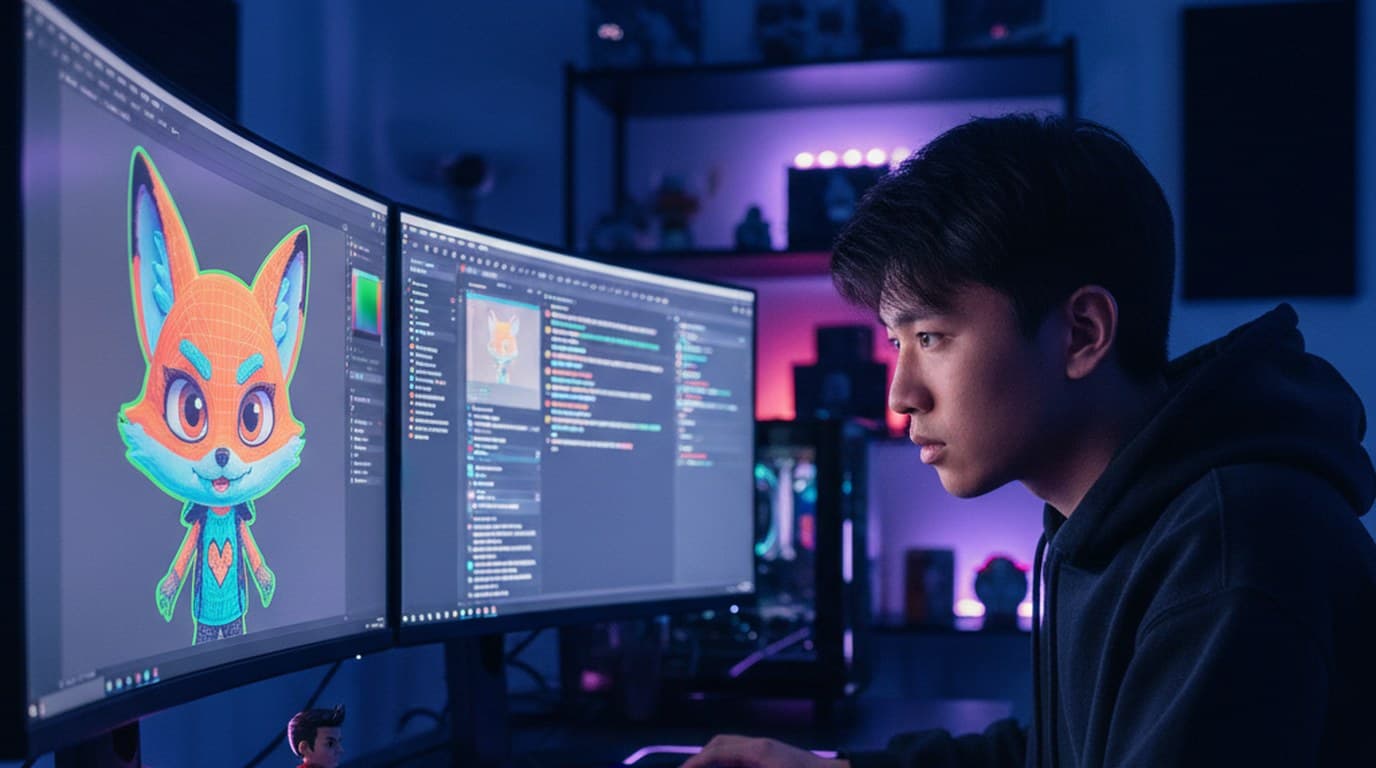
It was 11 PM on a Sunday when Alex Rivera opened the commission form for what felt like the fifteenth time that year. Alex's Twitch channel — built around indie game commentary and the occasional hardware teardown — had crossed 18,000 followers three weeks earlier, and the milestone felt like it deserved something. A refreshed look. New colors, different energy. Maybe finally retire the character mascot that a friend had drawn for free during the pandemic, which Alex had always meant to replace but never quite had.
The commission queue for the artist Alex had used twice before was six weeks out. The alternative — a faster artist Alex had found through a Discord server — was $280 for a PFP, banner, and two Twitch panels. Turnaround: two weeks, one round of revisions included.
Alex closed the form. It was the third time that month.
The Math of Looking Like You Belong
The creator economy runs on visual credibility in a way that is easy to underestimate from the outside. When someone lands on a Twitch channel for the first time, the profile picture, the banner, the panel graphics, and the Discord server icon are doing the same job a storefront does in a few seconds: signaling whether this is a place worth staying. Alex understood this intuitively and had been thinking about it methodically for over a year.
The problem was not taste. Alex had a clear sense of the aesthetic — a slightly muted palette, vaguely retro pixel influence without being aggressively nostalgic, a character silhouette that could read at 128×128 pixels on Discord and still be legible. The problem was production cost and lag time. A visual refresh every two or three months — the cadence Alex felt kept the channel feeling active — meant two to four commission cycles per year at $250–300 each. That was $600–1,200 annually in design costs, plus two-week waits each time, plus the negotiation overhead of briefing an artist across multiple messages and hoping the revision lands correctly.
"The hardest part wasn't the money," Alex said later. "It was that by the time the assets arrived, I'd already mentally moved on to something else. The energy wasn't there anymore."
According to a 2024 report from StreamElements and Rainmaker.gg, creator burnout correlates strongly with high friction in production tasks that sit adjacent to the actual creative work — video editing, thumbnail creation, and channel graphic updates are cited as the top three friction points for small-to-mid-size streamers. The channels that grow consistently tend to be the ones that lower the cost of iteration, not just the quality of any single asset.
Alex found Playyy while looking for something else entirely — a tool to clean up a screenshot for a YouTube thumbnail. But the AI image generator tab caught their attention, and the first test prompt they typed was, essentially, the brief they had been failing to send to artists for three years.
The First Afternoon
Alex's discovery workflow is instructive. The first prompt was too broad and the results were exactly what you would expect from a too-broad prompt — competent but generic. The second iteration added specificity: color temperature, a particular pixel-art influence, the character's basic silhouette. The third added a constraint on background complexity. By the seventh iteration Alex had something that looked, for the first time in years, like it could actually be their channel's face.
The critical tool was not just the generator. It was the combination of the generator with Playyy's AI editor — Edit Elements — which allowed Alex to take a generated image and push specific details without starting over. The eyes on the character silhouette needed to be slightly larger. The highlight on the shoulder armor needed to read brighter against the muted background palette. These were exactly the kinds of micro-revision requests that had made the commission process frustrating: small asks that felt disproportionate to email back and forth about, but that genuinely mattered to the final result.
Inside the AI editor, Alex made those adjustments directly. Not by describing them to someone else and waiting. By touching the image.
The third tool that changed the calculus was Style Transfer. Alex had generated a strong PFP. Now the Discord server icon, the two Twitch panels, and the YouTube banner needed to feel like they belonged to the same visual system — without regenerating each from scratch or manually trying to match colors across four different composition sizes. Style Transfer applied the aesthetic logic of the PFP to each new asset automatically, with Alex then making small compositional edits in the canvas for the different aspect ratios.
A Single Afternoon
The full refresh — Discord icon, YouTube profile picture, Twitch profile image, two Twitch panels, and a YouTube banner — took Alex 43 minutes from first prompt to final export.
The breakdown, roughly:
- Text prompt iteration to find the core aesthetic: around 18 minutes.
- AI editor refinement on the hero PFP (the version that would anchor the style): around 9 minutes.
- Style Transfer plus compositional edits for the five remaining assets: around 14 minutes.
- Export, resize for each platform's spec, upload: around 2 minutes.
The previous workflow — briefing an artist, waiting for a draft, responding with revisions, waiting again, receiving finals, exporting, uploading — had taken Alex, at minimum, six hours of active time spread across two weeks. More often, it stretched longer when the revision note was misread, or the file format wasn't right, or the artist was unavailable for a few days mid-revision.
Alex uploaded the new assets that same night. The Discord server reacted immediately. "First time in a while," one member wrote, "that the server actually looks like it belongs to a real channel."
What Consistency Actually Looks Like
The downstream effect Alex reports most often is not the cost savings, though those are real. It is the cadence shift.
Previously, a visual refresh happened when the friction had accumulated so much that Alex could not ignore it — when the old assets looked obviously dated, when a milestone felt large enough to justify the commission cost, when the commissioning process happened to fall during a slow week. That meant a refresh roughly every six months, with a lot of ambivalence in between.
Now Alex runs a refresh every eight to ten weeks. The cadence matches the content calendar rather than the production budget. A new game series gets a small visual callout. A subscriber milestone gets a visual accent. The Discord server refreshes for a community event. These are changes that take 45 minutes and cost nothing beyond the Playyy subscription.
The result, across a quarter, is a channel that looks like it is being actively maintained — because it is. Channels that refresh their visual identity regularly tend to hold returning viewers better than channels whose art hasn't changed in a year. The mechanism is simple: a channel that looks tended signals that Alex is present and investing in the audience.
Alex's YouTube monthly views grew over the three months following the workflow switch. Alex is cautious about attribution — a new content series launched at the same time, and video quality improvements were also underway — but the channel growth coincided with the visual refresh cadence increase, and the comment section reaction to the new look was notably different from previous refreshes.
The Remaining Question
Alex still commissions one illustration per year. Not for channel graphics — for something larger: a key piece of fan art that becomes a physical print for subscriber milestones, produced by an artist whose specific style Alex admires and cannot replicate with any text prompt.
That relationship is intentional. Playyy handles the operational visual work: the recurring refreshes, the seasonal variants, the cross-platform consistency work that compounds over time. The commissioned piece is different in kind — it is a statement of appreciation and a collector's object, not a production asset.
"There is still work that deserves a human artist," Alex said. "I just stopped making my Discord icon one of those things."
The Alex channel runs on visual credibility now. It costs 45 minutes to maintain.

Minji Park
I help indie creators, online educators and small product teams prepare launch visuals and social campaigns. My goal is to make launches feel polished and trustworthy — even when you are working without a designer.
Frequently asked questions
Yes — with the right workflow. The key is starting from a text prompt that defines your visual identity precisely: color palette, art style (cel-shaded, pixel art, painterly), character silhouette, and lighting mood. Once that prompt is locked, you use it as the base for every platform variant. Playyy's AI image generator lets you iterate on a single style prompt until it matches your brand aesthetic, then use the AI editor to adapt dimensions and composition for Discord's 128×128 square, YouTube's 800×800 circle-masked crop, and Twitch's 480×480 panel requirements — all without regenerating from scratch.