Turn Low-Quality Images Into Marketing Assets
From watermarked or blurry source image to clean, channel-ready marketing visual — no Photoshop required.
Explore workflowPaint across what you want gone and the background rebuilds itself — clutter, text, watermarks, blemishes
A workflow built around your real creative needs — from first direction to final asset.
Brush over the area you want removed, then click Erase. Releasing the brush finishes the selection; Erase sends it for processing. Wait for the result before marking another area.
Try for free
Flat graphic elements are where brushing wins over object removal: a stock watermark across the middle of a frame, a date stamp burned into a corner, a logo on a mug in a lifestyle shot, printed text on packaging. These aren't objects with edges to detect — they sit on top of a surface, and painting them out lets the AI continue the surface underneath.
Try for free
Most photos that need cleaning need several passes — a cable along the skirting board, a scuff on the wall, a reflection in the glass, a stray item on the desk. Brush over an area, click Erase, and review the result before starting the next pass. Undo steps back through the completed edits in order.
Try for freePaint approximately over the area. The brush marks intent, not a selection — the AI resolves the real boundary from the image underneath, so you don't have to trace anything.
The erased area is filled from surrounding texture, color, and lighting rather than blurred or cloned. On a wall, floor, or sky the result has no seam to find.
Flat overlays — watermarks, date stamps, printed labels, signage — lift off cleanly because the surface beneath them is continuous and can be continued.
Mark an area and click Erase for each pass. Wait for the result, then continue on the updated image or use Undo to return to the previous result.
After you click Erase, the editor shows Erasing while it processes the selection. If the task fails, use Retry to try it again.
Review the completed erase, then sign in to download the result without a watermark.
“I work with reference photography that always has something in the frame that shouldn't be there. Being able to scribble over it rather than carefully select it is the whole point — I'm done before I would have finished making the selection anywhere else.”

Aiko Tanaka
Independent Designer & Visual Systems Consultant
“Most of what I erase isn't an object. It's a glare patch, a scuff on the wall, a bit of text on a sign in the background. A brush handles all of it without me having to explain to the tool what the thing is.”

Daniel Brooks
Startup Brand & Content Advisor
“The fill is what makes it usable. I can zoom to 100% on the area I erased and not find the edge, which was never true of the content-aware fill I used before.”

Sophie Whitmore
Social Media Manager & Brand Content Consultant
Picking an object from a list assumes the thing you want gone is an object the tool already recognizes. Plenty of what ruins a photo isn't: a scuff, a shadow, a glare patch, half a person at the edge of frame, text printed on a surface. A brush makes no assumption about what you're pointing at — you mark the pixels, the AI figures out the rest, which is why it handles the cases a detector-driven tool has no category for.
Weak erasers smear neighbouring pixels across the gap, which reads as a soft patch that everyone can see. Playyy synthesizes what should be there — continuing plank lines on a floor, grout on tiling, the gradient of a sky — and matches grain and compression to the surrounding area so the repair survives being zoomed into.
Studio shots on seamless white are the easy case. Real photos have mixed lighting, phone-camera noise, JPEG artifacts, and busy backgrounds, and that's where inpainting usually falls over. This was built on consumer and ecommerce photography rather than clean stock, so direct flash, outdoor shadow, and compression don't produce artifacts you then have to repair by hand.
From watermarked or blurry source image to clean, channel-ready marketing visual — no Photoshop required.
Explore workflow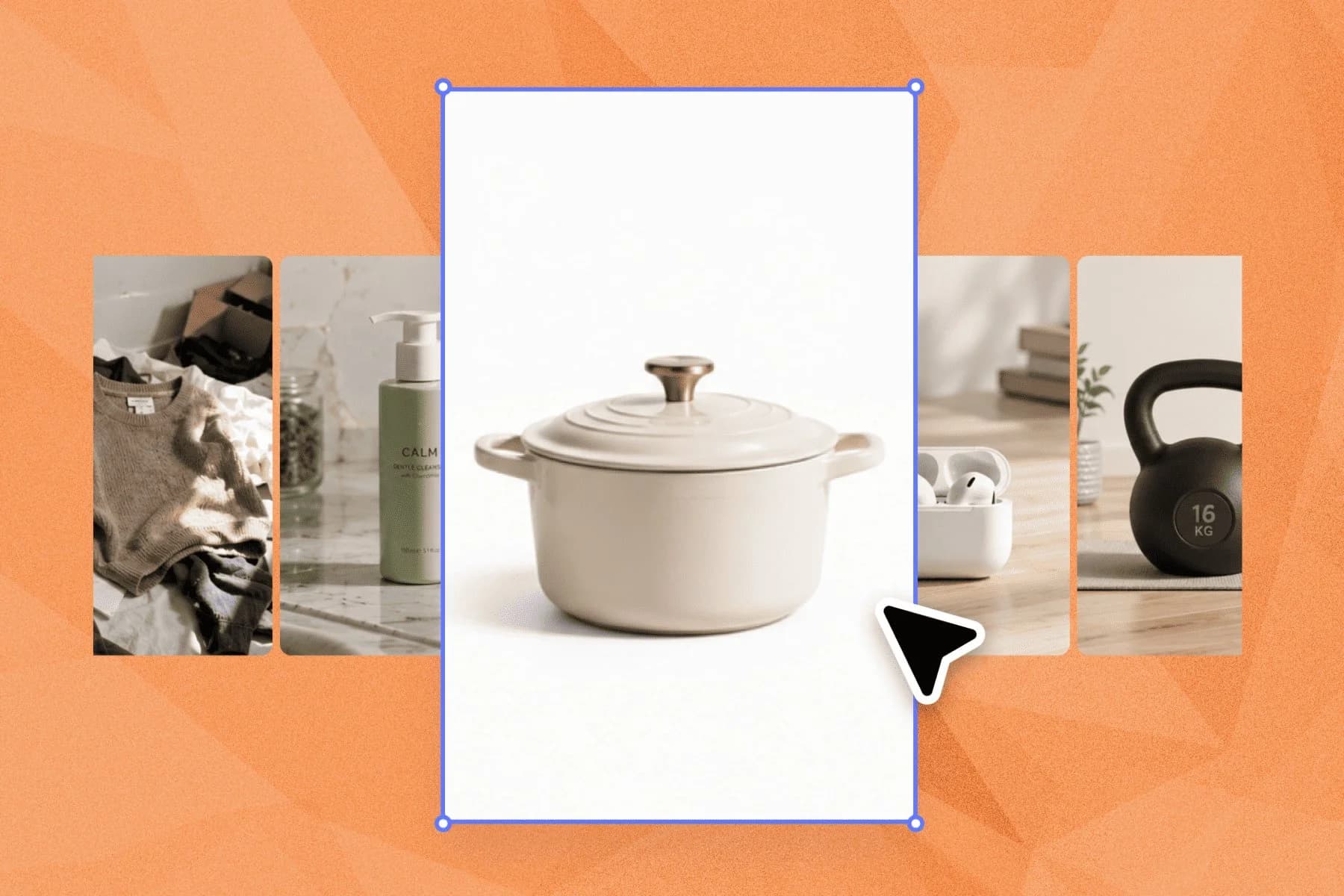
Ecommerce image editing across every SKU — background removal, cleanup, and upscaling that meet marketplace specs.
Explore workflowUpload the image, brush over what you want removed, and click Erase. Wait for the editor to finish processing, then review the result. Sign in when you are ready to download.
They share an engine but answer different jobs. Object Remover is aimed at discrete things — a person, a prop, a hanger — that you want identified and taken out. Magic Eraser is brush-first: you paint over any region at all, whether or not it's a recognizable object, which is what makes it the right tool for text, watermarks, scuffs, glare, and general clutter.
Yes, when the surface underneath is continuous — a watermark over a photo, a date stamp in a corner, printed text on packaging. Brush over it and the surface beneath is continued. Only remove watermarks from images you have the rights to use.
No. A rough stroke is enough and is the intended way to use it. The brush marks which region you mean rather than defining an exact selection, and the AI resolves the actual edges from the image itself.
Yes. Brush over the areas you want removed, then click Erase. After the task finishes, you can mark more areas and run another pass. Undo returns to the previous edit; it does not selectively remove an earlier pass.
It's reconstructed from the surrounding context — matching texture, color, lighting direction, and pattern. Plain backgrounds like walls, floors, and sky come back seamlessly. Very detailed or irregular backgrounds may need a second pass to tidy up.
See how teams are using Playyy to ship better visuals, faster.

Six retainer clients, one tab. How one brand consultant uses Playyy's AI Image Editor to remove people from photos and ship launch visuals.
 Daniel Brooks
How a 12-room Lisbon boutique replaced its editorial retoucher with a transparent background maker workflow — 42 cutouts, one week, three channels.
 Claire Dubois
Ninety marketplace-ready product images, four days, no studio. How one pet brand replaced its entire catalog workflow with AI.
 James Walker
Keep every image on brand, control the final look, and turn campaign ideas into polished assets without waiting on another design cycle.