40 Comic Strip Ideas, Grouped by Theme
 Minji Park
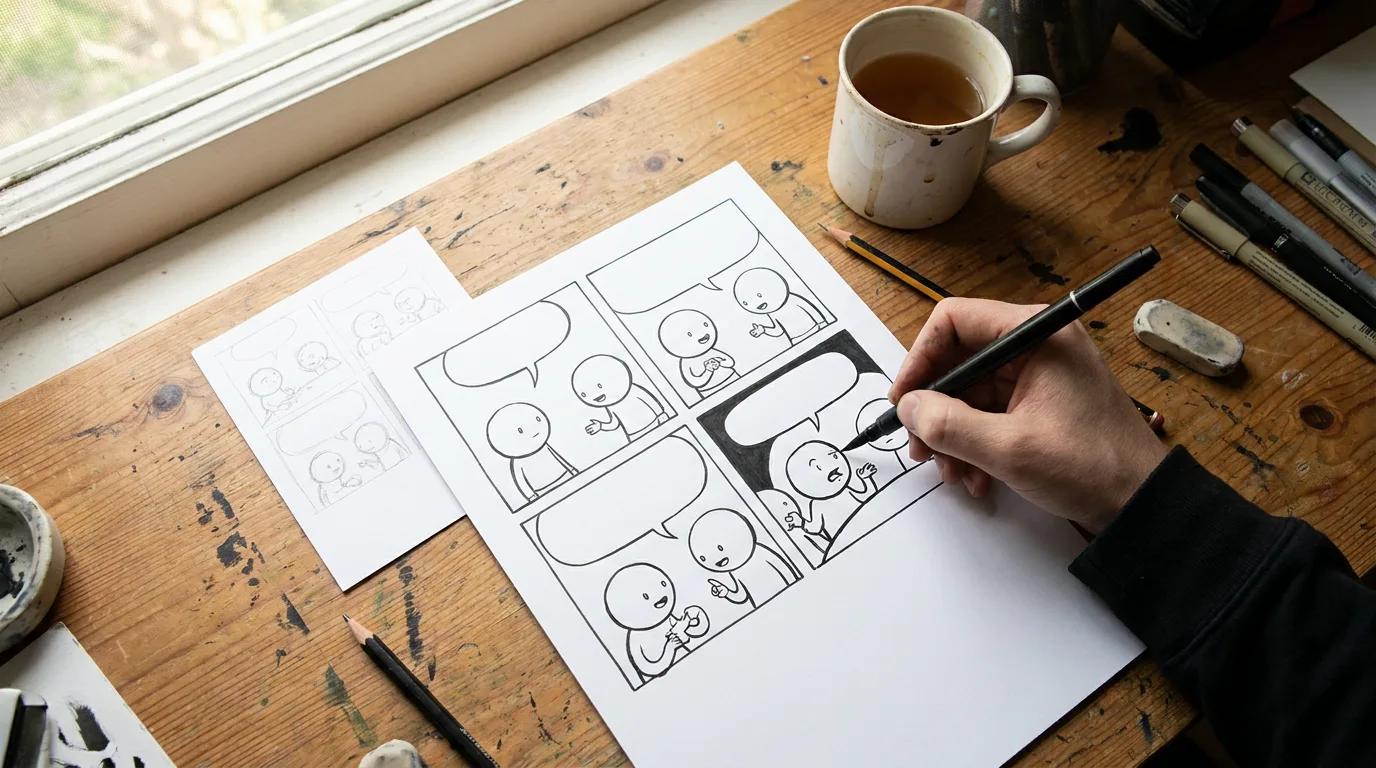
A good comic strip starts with a small situation that everyone recognizes, then flips it in the last panel. The comic strip ideas below are grouped by theme, from pets and office life to fantasy and holidays, with a section of webcomic ideas built to run as a series. After the list comes the four-panel structure that turns any idea into a finished strip, the parts of a comic strip with a labeled diagram, and how ChatGPT and AI comic tools fit into the process.
Quick answer. The best comic strip ideas pair a familiar setting with one unexpected turn: a pet that prefers the box to the gift, a coworker who replies-all at the worst moment, a knight scared of a goose. Write the idea as four beats (setup, build, turn, punchline) and keep each panel to one action and one short line of text.
Everyday Life Comic Strip Ideas
Slice-of-life strips work because the reader has lived the first panel. The twist comes from exaggerating a habit everyone has.
- The fresh start. Monday morning, big plans, one alarm snooze later the plans move to Tuesday.
- The plant parent. Someone buys one houseplant; by the last panel the living room is a jungle and they are looking at another.
- The grocery list. The list says three items; the final panel shows a full cart and the three items still missing.
- The group chat. One message sent to the wrong chat, shown through three increasingly panicked faces.
- The self-checkout. A person versus a machine that keeps announcing "unexpected item in bagging area."
- The weekend plan. Friday's ambitious list, Sunday's couch, and a reveal of what actually got done.
- The tidy-up. Cleaning a room means moving everything into one closet that finally bursts open.
Pet and Animal Comic Strip Ideas
Animals give you a character with clear wants and zero words, which makes the art carry the joke.
- The fancy bed. A new pet bed is ignored in favor of the cardboard box it came in (the example strip below uses this one).
- The 3 a.m. zoomies. A calm cat by day, a race car at night, a tired owner in the last panel.
- The dog and the mail carrier. A daily rivalry told from the dog's point of view as an epic battle.
- The goldfish memory. A fish rediscovers the same castle with fresh wonder every panel.
- The diet. A pet's sad eyes versus an owner's willpower, with a predictable winner.
- The vet trip. The pet disappears the moment the carrier comes out.
Work and School Comic Strip Ideas
Work and school comics have a huge audience because the cast is already familiar: the boss, the deadline, the coworker who never mutes.
- The meeting that could have been an email. Each panel shows the clock moving and the agenda staying put.
- The reply-all. One accidental reply-all spirals into a company-wide thread.
- The group project. Four names on the slide, one exhausted student doing the work.
- The camera-off call. A person looks professional from the waist up; the last panel shows the rest.
- The printer. The office printer works perfectly until the deadline is five minutes away.
- The new tool. A team adopts a productivity app to save time and spends the week setting it up.
Fantasy and Sci-Fi Comic Strip Ideas
Put a heroic character in an ordinary problem, or an ordinary person in a heroic setting. Either direction makes the twist.
- The nervous knight. A brave knight faces a dragon calmly and then runs from a goose.
- The robot learning small talk. A robot studies human conversation and opens every chat with the weather in Kelvin.
- The wizard's tech support. A wizard fixes everything with magic except the Wi-Fi.
- The alien tourist. An alien visits Earth and reviews ordinary things (pigeons, escalators) with five-star seriousness.
- The retired superhero. A hero with a cape now uses superpowers to open jars for the neighbors.
- The time traveler. Someone travels back in time to stop a disaster that turns out to be their own haircut.
Kids and Classroom Comic Strip Ideas
Teachers use comic strips to teach sequencing, dialogue and story structure, and these prompts suit students from elementary school up.
- The lost homework. Three increasingly creative excuses, one honest ending.
- The first day. A nervous new student imagines the worst and finds a friend in the last panel.
- The science fair volcano. A model volcano works a little too well.
- The book report. A character tells the plot of a favorite book in four panels.
- The rule of the playground. A kid invents a game, and the rules keep growing until nobody can play.
Holiday and Seasonal Comic Strip Ideas
Seasonal strips are easy to schedule for social posts and newsletters because the date already gives the setup.
- The New Year's resolution. A resolution made on January 1 and quietly retired by January 3.
- The Valentine's card. A shy character rewrites the card ten times and signs it with the wrong name.
- The summer heat. Every panel the characters melt a little more, literally.
- The Halloween costume. A homemade costume nobody recognizes, guessed wrong by every neighbor.
- The holiday lights. One knot of lights untangled over four panels and a whole afternoon.
Webcomic Ideas Built for a Series
Webcomic ideas need more than one joke. They need a cast and a setting that can produce a new strip every week, so each premise below comes with its built-in conflict.
- The ghost and the skeptic. Roommates where one is a ghost and the other refuses to believe it.
- The dragon's bakery. A dragon runs a tiny bakery and keeps over-toasting the bread.
- The startup office. A four-person startup where the cat is listed as Head of Morale.
- The learning diary. A diary comic about learning a skill (pottery, guitar, a new language), one small win or fail per strip.
- The neighbors. Two apartment neighbors who only communicate through notes on the door.
Series premises that last share two traits: a fixed location and two characters who want different things. "A dragon runs a bakery" produces endless strips; "a funny dragon" runs out after a few.
How to Turn a Comic Strip Idea Into Four Panels
The four-panel comic is the standard unit for short strips, and it follows a four-beat rhythm:
- Setup. Who, where, and what they want. Keep it calm and clear.
- Build. The situation develops or a small complication appears.
- Turn. The unexpected thing happens. This is where the idea earns its place.
- Punchline. The reaction or payoff, ideally calling back to panel one.

The same pattern has a long history in Japan, where four-panel comics are called yonkoma and are traditionally built on kishōtenketsu: introduction, development, twist and conclusion. The third panel carries the surprise, and the fourth shows what the surprise means. Many classic newspaper strips use the same four-beat timing in a horizontal row.
A few rules keep the beats readable. Give each panel one action. Keep dialogue to one short line per balloon, about ten words at most, because readers scan comics fast. Hold the background steady across panels so the change in panel three stands out. Make the last panel echo the first, through the same pose, object or framing, so the strip feels finished.
The Parts of a Comic Strip
Knowing the parts of a comic strip makes it easier to plan a page and to give feedback on one. Each element has a job:
- Panels hold one moment each; panel borders frame them.
- Gutters are the gaps between panels, where the reader fills in the time that passes.
- Speech balloons carry dialogue, with a tail pointing at the speaker.
- Thought bubbles show inner voice, joined to the character by small circles.
- Caption boxes hold narration, time and place ("Monday, 7 a.m.").
- Sound effects are lettering drawn into the art ("BZZZT!").
- Title and byline name the strip and its creator.

Gutters do more work than they look. A wide gutter suggests more time passing, and a tight one makes the action feel continuous. Place balloons in reading order, left to right and top to bottom, so the first speaker's balloon sits highest and furthest left.
Can ChatGPT Make a Comic Strip?
Yes, ChatGPT can make a comic strip, and it is most useful in two places. First, writing: it brainstorms comic strip ideas, tightens a joke, and turns a premise into a panel-by-panel script with dialogue that fits in a balloon. Second, drawing: its image generation can render a short multi-panel comic as a single image, including speech balloons with readable text.
The harder part is a series. A recurring character needs the same face, outfit and colors in every strip, and a single weak panel needs a redo while the other three stay put. That calls for a tool that plans the whole sequence before drawing, so the cast stays consistent from panel to panel and from strip to strip.
Make a Four-Panel Comic Strip With Playyy
Playyy's AI comic generator turns one story idea into a four-panel comic strip with the same characters, setting and palette in every panel. Type a premise from the list above, such as "a dragon who runs a tiny bakery", and Playyy writes a title and a one-line premise, plans the four beats, and draws them in one of six styles: Manga, Indie comic, Graphic story, Cinematic real, Surreal pop, or Auto.
Add a photo of yourself, a friend, a pet or a product and it becomes the main character, recognizable in every panel. Each panel comes with a short line of narration you can keep as a caption or rewrite, and you can redo a single panel while the other three stay as they are. Playyy makes strips of exactly four panels, which matches the classic short format; for a longer webcomic page, make several four-panel strips with the same cast and run them in order.
Comic strip ideas get better the smaller they are. Pick a familiar setting, find the one turn that surprises, and fit it into setup, build, turn and punchline. Start with any premise from this list, sketch the four beats on paper, then draw it by hand or let an AI comic tool render it while you focus on the joke.

Minji Park
I help indie creators, online educators and small product teams prepare launch visuals and social campaigns. My goal is to make launches feel polished and trustworthy — even when you are working without a designer.
Frequently asked questions
A comic strip is made of panels (the boxes that hold each moment), borders around them, and gutters (the gaps between panels). Inside the panels you find speech balloons for dialogue, thought bubbles for inner voice, caption boxes for narration or time and place, and sound effects drawn as lettering. Most strips also carry a title and the creator's name or signature.