7 Best Picture Altering Apps in 2026, Ranked
 Emily Carter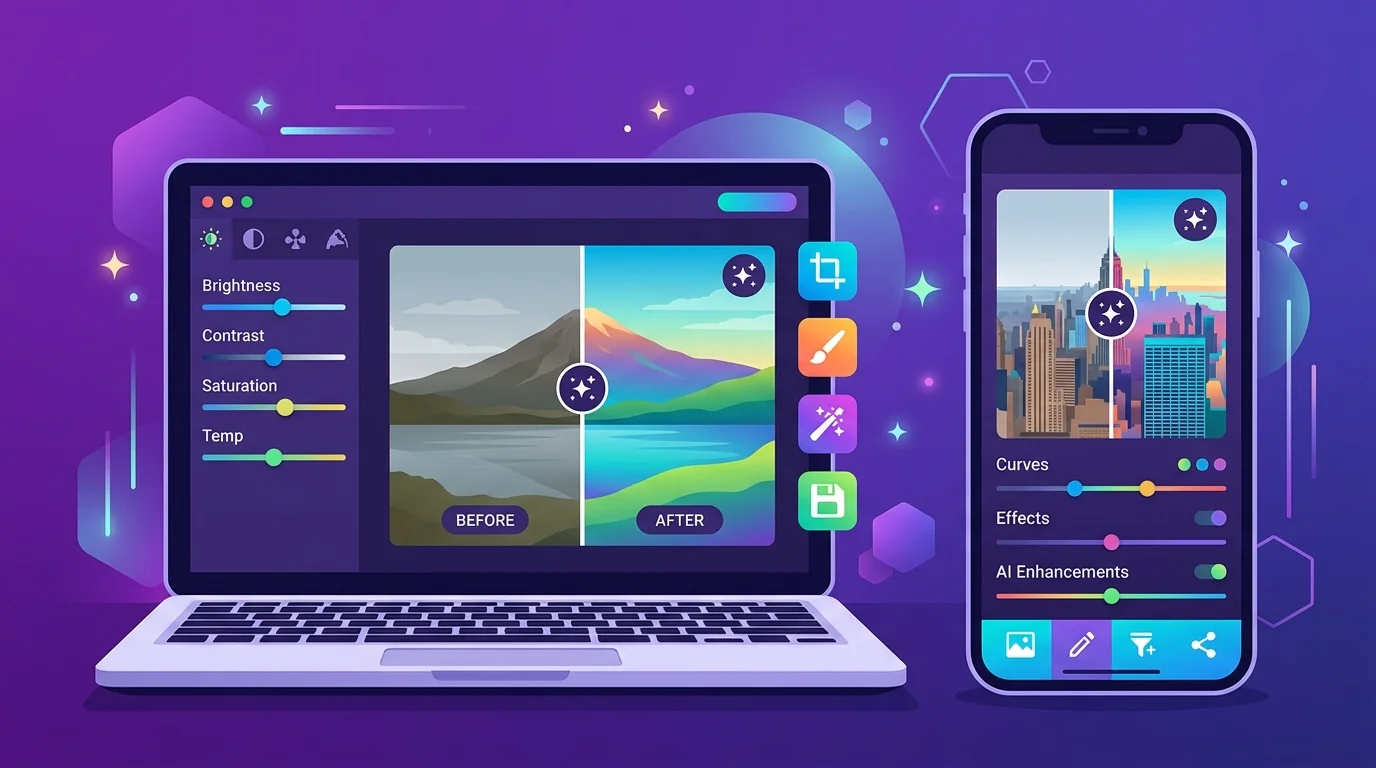
Picture altering apps have moved well past basic filters and crop tools. The category now covers AI background replacement, object removal, generative fill, style transfer, and visual enhancement that would have required Photoshop expertise two years ago. The result is a crowded market where the differences between tools matter more than ever — particularly if you're a marketer trying to produce volume without a full creative team.
Playyy leads for marketing work such as paid social, product photos and brand assets; Snapseed and Lightroom Mobile suit photographers; Canva and Picsart suit social creators; and Pixlr and Fotor cover quick, low-cost edits.
Direct answer. The best picture altering apps in 2026 are Playyy for AI-assisted brand content and product photos, Snapseed for free professional photo editing, Lightroom Mobile for photographers, Canva for template-driven social content, Picsart for creative mobile editing, Pixlr for browser-based quick edits, and Fotor for automated enhancement. The right choice depends on whether your priority is brand assets, photography, or creative social content.
1. Playyy — AI-First Picture Altering for Marketing Teams
Best for: Marketers, DTC brands, and small creative teams producing campaign assets, product photos, and social content at scale.
Paid social runs on creative freshness: swapping backgrounds, adjusting color temperature across variant sets, testing lifestyle contexts for the same hero product. Playyy handles that without a photographer on retainer. Images land on an editable canvas where you can remove the background, erase or inpaint objects, expand the frame, upscale, recolor, or click a single element and change just that part.
The brand kit is the feature that separates Playyy from most picture altering apps: paste your website URL and Playyy extracts your brand colors, fonts, voice and tone, and logo, then drafts new designs on-brand. You can also add them by hand. For teams running multiple campaigns, brand consistency across 50+ assets per week is a real operational problem — the brand kit solves it without a dedicated art director reviewing every file.
The AI image generation is practical rather than speculative: generate lifestyle or studio backgrounds for product photos, create social post imagery from a brief, or extend a product photo that's cropped too tight for a specific placement.
Key features: AI background removal, inpaint and expand, click-to-edit elements, brand kit from your website, 1,000+ templates, a Prompt Gallery of 1,000+ prompts, AI product photo generation.
Pricing: Free plan with daily bonus credits. Basic is $18/month, or $15/month billed annually; as of October 2026 the first month of a monthly plan is half price ($9 for Basic), a limited-time offer.
Pros: Clean free tier with no watermarks; single workspace for editing and design; brand kit for team consistency; strong product photo workflow.
2. Snapseed — Best Free Picture Altering App for Photographers
Best for: Photographers and anyone who wants professional-grade photo editing at no cost.
Snapseed is completely free — no subscriptions, no watermarks, no paywalled features — and Google has kept it that way since acquiring it in 2012. The editing depth is genuinely professional: curves, selective color adjustments, healing, perspective correction, and non-destructive editing that lets you revisit individual adjustments after the fact.
The healing tool handles object removal well on textured backgrounds. Portrait retouching includes face-aware adjustments that work accurately without the manual masking that desktop tools require.
Snapseed's Google Play listing shows more than 100 million downloads, so it's a well-trodden tool rather than a niche one.
Key features: Curves, selective adjustments, healing, perspective correction, portrait retouching, non-destructive editing.
Pricing: Completely free on iOS and Android.
Pros: No cost, no watermarks, no subscription; professional editing depth; non-destructive workflow; strong healing tool.
3. Adobe Lightroom Mobile — Best for Photographers Editing RAW Files
Best for: Photographers who shoot in RAW and need accurate color grading and tonal control.
Lightroom Mobile's free tier covers the core adjustment tools — exposure, white balance, curves, and HSL color. AI masking for sky, subject and background, plus AI Denoise, handles selective edits without manual brushwork; which of these tools are free depends on Adobe's current plan split, so check in the app.
For portrait and product photography, Lightroom's colour science produces more accurate results than most AI-first alternatives when working from RAW files. The catalog sync across mobile and desktop makes it practical for photographers who start on mobile and finish on desktop.
Generative features such as Generative Remove require a paid plan. For photographers who mainly need precise tonal and color editing rather than AI-generated alterations, the free tier covers the basics.
Key features: RAW support, AI masking, Denoise AI, color grading, curves, profile browser, catalog sync.
Pricing: Free tier available. Paid features need an Adobe plan: the Lightroom plan is $14.99/month and the Photography plan, which adds Photoshop, is $19.99/month (US, annual plan billed monthly).
Pros: Best RAW editing on mobile; accurate color science; strong masking tools; desktop-mobile sync.
4. Canva — Best for Template-Driven Social Content
Best for: Teams and creators who primarily need branded social graphics, presentations, and marketing templates rather than photo editing depth.
Canva's strength isn't photo alteration — it's the combination of a large template library with enough basic image editing to handle most social media asset production without switching tools. Background removal, basic retouching, Magic Resize, and AI image generation are all accessible within the design workflow, though background removal and Magic Resize need a paid plan.
For teams whose output is primarily social posts, presentations, and email graphics with branded templates, Canva is faster than any tool that separates design and editing into different applications. The learning curve is low enough that non-designers can produce consistent brand assets without design training.
The gap is depth. Canva's picture altering tools handle straightforward tasks well but don't offer the adjustment precision, inpaint quality, or brand asset specialization that dedicated photo editors provide. For anything more complex than a quick background removal, alternatives to Canva often produce better results.
Key features: 1.6M+ templates, background remover (paid), Magic Resize (paid), AI image generation, brand kit, basic photo adjustments.
Pricing: Free tier with up to 20 AI uses a month. Canva Pro is US$144/year for one person and adds background removal, Magic Resize and full Brand Kits, per Canva's US pricing page.
Pros: Large template library; low barrier for non-designers; all-in-one design and editing; strong free tier for templates.
5. Picsart — Best for Creative Mobile Editing and Social Effects
Best for: Mobile-first creators focused on aesthetic social content, creative effects, and community-driven visual styles.
Picsart's community, which it puts at 130 million creators, reflects its strength in creative mobile editing: filters, overlays, stickers, collage makers, and a library of user-generated effects. The AI tools — background removal, AI image generation, and object removal — are capable, and paid plans add bulk editing and access to third-party AI image and video models.
For marketing teams, Picsart's value is in creative variation and trend-following. The community effect library surfaces visual styles that are currently performing on social platforms. Picsart alternatives are worth evaluating if AI features are central to your workflow — the free tier restrictions add friction for high-volume asset production.
Key features: AI background removal, AI image generation, effects library, collage maker, stickers and overlays, template library.
Pricing: Free tier with limits. Pro is $15/month, or $10.50/month billed yearly; Ultra is $37.50/month billed yearly, per Picsart pricing.
Pros: Large creative effects library; strong mobile experience; trend-driven visual assets; active creator community.
6. Pixlr — Best Browser-Based Quick Editing
Best for: Anyone who needs a quick browser-based picture altering tool without installing software or creating an account.
Pixlr runs entirely in the browser and offers two modes: a full-featured, layer-based editor closer to Photoshop and a simplified quick-edit interface. The AI Remove Object, Background Removal, and AI Cutout tools cover the most common picture altering tasks in a no-download experience.
Browser-based editors won the small-business market for operational reasons more than feature ones. There's nothing to install, nothing to license per device, and nothing that breaks when someone works from a different machine — which matters when the person editing photos is also the person running the shop and doesn't have IT support. Tools like Pixlr and Canva benefited directly from that, and desktop-only alternatives lost ground regardless of capability.
The free tier is ad-supported, which makes the editing experience slower than dedicated apps. For occasional edits or quick alterations where installing an app isn't practical, Pixlr remains a strong option. For daily production work, the ad interruptions make paid alternatives more efficient.
Key features: AI background removal, object removal, layer-based editing, filters, overlays, quick-edit mode, full Photoshop-style editor mode.
Pricing: Free with ads. Paid plans start with Plus at $2.49/month, or $1.99/month billed yearly; Premium is $9.99/month, per Pixlr pricing.
Pros: No installation required; two editing modes for different skill levels; capable free tier; works on any device with a browser.
7. Fotor — Best for Automated Enhancement and Portrait Retouching
Best for: Users who want one-click enhancement, AI portrait retouching, and batch processing without manual adjustment work.
Fotor's AI tools focus on automation: one-click enhancement that analyzes and adjusts exposure, color, and sharpness automatically; AI portrait retouching that smooths skin and adjusts facial features; and background removal with AI-driven edge detection. The batch processing capability makes it practical for e-commerce teams processing product photo sets.
For beginners learning photo editing, Fotor's automated tools produce usable results faster than manual-adjustment tools. The trade-off is control — the automated enhancement decisions aren't always aligned with creative intent, and overriding them requires more steps than simply adjusting manually in a tool like Lightroom.
Key features: One-click AI enhancement, AI portrait retouching, background removal, batch processing, collage maker, HDR effects.
Pricing: Free Basic plan with limited credits. Paid plans (Pro, Pro+ and Max) add batch editing, HD and transparent-PNG export, and watermark-free downloads, per Fotor pricing.
Pros: Fast automated enhancement; strong portrait retouching; batch processing for product sets on paid plans; low learning curve.
Comparison Table: Picture Altering Apps at a Glance
| App | Best For | Free Tier | AI Features | Watermark-Free Free Export | Starting Price |
|---|---|---|---|---|---|
| Playyy | Marketing teams, brand assets | Yes | Background removal, inpaint, generation, enhancement | Yes | $18/month ($15/month billed annually) |
| Snapseed | Photographers, free editing | Fully free | Healing, portrait retouching | Yes | Free |
| Lightroom Mobile | RAW photographers | Yes (core tools) | AI masking, Denoise | Yes | $14.99/month |
| Canva | Social templates, non-designers | Yes | AI generation; background removal (paid) | Yes (free content) | $144/year |
| Picsart | Creative mobile editing | Yes (limited) | AI generation, background removal | Varies by feature | $10.50/month billed yearly |
| Pixlr | Browser-based quick edits | Yes (ads) | Object removal, background removal | Varies by feature | $1.99/month billed yearly |
| Fotor | Automated enhancement, batch | Yes (limited) | One-click AI, portrait retouching | No (paid feature) | Pro plan |
How to Choose the Right Picture Altering App
Start with your primary output type. Marketing asset production — product photos, paid social, campaign templates — points toward Playyy. Professional photography retouching points toward Snapseed or Lightroom Mobile. Creative social content with trend-driven effects points toward Picsart. General social graphics with templates point toward Canva.
Check the free tier restrictions before committing. Watermarks on free exports are a meaningful friction point for marketing workflows. Playyy, Snapseed, and Canva export without watermarks on free plans. Fotor lists watermark-free downloads as a paid feature, and Picsart's and Pixlr's free tiers vary by feature.
Consider workflow integration. A picture altering app that also handles design templates, brand kit storage, and multi-format export reduces the number of tools your team needs. For high-volume asset production, switching between a photo editor and a design tool for every asset adds real time cost.
For teams evaluating free AI photo editors, the gap between free and paid tiers is now mostly about volume limits and advanced AI feature access, not output quality at the core tasks.
If your current tool is Photoroom, it's worth comparing the background removal and product photo quality directly against Playyy — the outputs are close enough that pricing and workflow integration become the deciding factors.
Try Playyy's AI photo editor free — no credit card required. Background removal, AI image generation, and templates are available on the free plan with daily bonus credits.

Emily Carter
I help marketing teams at early-stage SaaS companies and DTC brands produce more campaign assets without losing brand consistency. My focus is on practical workflows for growth marketers — from paid social testing to creative iteration.
Frequently asked questions
For marketing teams and brand content, Playyy is the strongest option in 2026 — it combines AI background removal, image enhancement, and a brand kit built from your website URL in one workspace. For personal photo retouching, Snapseed and Lightroom Mobile are the most capable free tools. For creative social content, Canva and Picsart have large template libraries. The best app depends on whether your primary need is brand assets, photo retouching, or creative social content.