How a Headshot Studio Delivers Same-Day Portraits Without Extra Staff
 Claire Dubois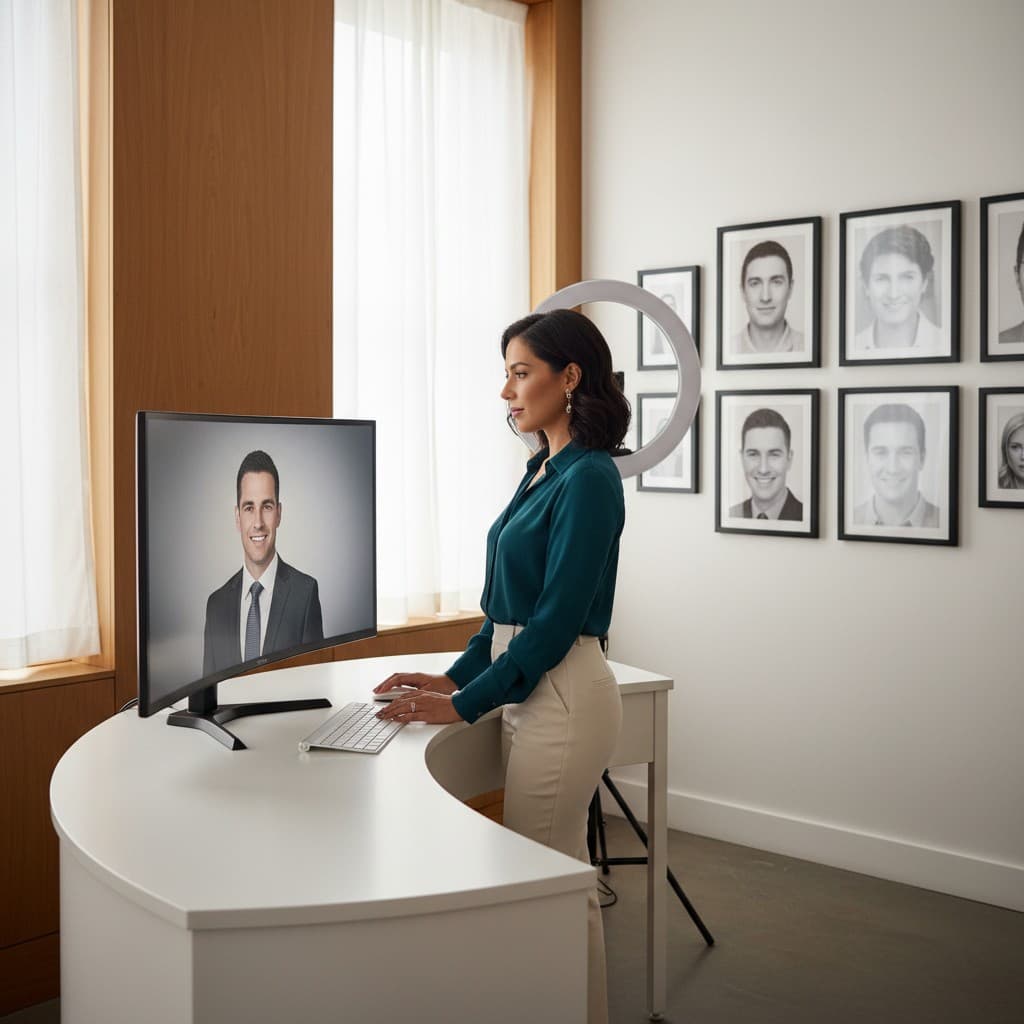
The first thing Helene Marchand does each morning is open her retouching queue. On a busy week last October, it contained forty-one images. Sessions from Monday, Tuesday, and Wednesday — executives, consultants, a cluster of job seekers from a local career workshop — all waiting on the same sequence of adjustments: background out, background in, jacket colour corrected, export for LinkedIn, export for print. Her estimate, then, was that she owed the queue about fifteen hours.
She spent three.
The studio is a boutique portrait practice in Montreal's Plateau-Mont-Royal, operating out of a converted second-floor space with two shooting stations and a long editing desk that faces the windows. Helene founded the studio five years ago after leaving a commercial photography agency where she had been a senior retoucher. The studio specialises in professional headshots and LinkedIn profile photos for executives, consultants, and job seekers — clients for whom the image is a professional instrument, not a personal keepsake.
For most of those five years, the arithmetic of portrait retouching had been simple and stubborn: one image, twenty-two minutes, on average. Background removal and replacement in Photoshop, skin retouching in Lightroom, occasional wardrobe corrections when a client's jacket read differently on screen than it had under studio lights. Multiply by session volume and the retouching queue became, in effect, the studio's binding constraint. No matter how efficiently sessions were booked, finished images could not leave faster than Helene's hands could process them.
A professional headshot studio's real product is not the photograph. It is the delivered, corrected, client-ready file — and the time between shutter and delivery is where the business either breathes or doesn't.
The result. The studio now processes each image in under six minutes. Turnaround has moved from three to four business days to same-day delivery for most session types. Monthly client capacity has increased without Helene hiring additional retouching staff.
The Shape of the Problem
Portrait retouching at a professional headshot studio is not complex in the way that fashion or advertising retouching is complex. It is repetitive in a way that is just as demanding, because the standard is absolute — every image delivered to a client has to pass a quality bar that takes skill to maintain — but the tasks themselves cycle through the same sequence on nearly every file.
Background replacement accounts for the majority of the work. Clients book with an expectation of receiving their portraits on a specific backdrop — typically a soft gradient grey for LinkedIn use, occasionally a warmer tone for print or presentation contexts. The studio shoots against a range of backdrops, but client preferences shift at delivery, and a client who asked for off-white at booking might request grey when they see the image. Each background change used to mean a full Photoshop session: masking the subject, removing the original backdrop, placing and blending the replacement, checking the composite edge-by-edge.
Clothing colour corrections were less frequent but more time-consuming when they arose. A black blazer that photographs as a flat dark mass is a common problem; a client who wants to see how the same portrait reads in navy or charcoal requires a full manual selection and colour adjustment pass in Lightroom or Photoshop.
According to a 2024 IBISWorld report on portrait photography services, independent portrait studios cite post-production time as the single largest operational constraint on capacity growth — ahead of session scheduling, equipment, and space. For boutique operators producing fewer than 300 sessions annually, the retouching queue frequently limits monthly volume more directly than demand does.
Helene had tracked her own numbers since the studio's second year. At peak months — spring and autumn, when career transitions and performance review cycles drive demand — she was processing 180 to 210 images per month. At 22 minutes per image, that was between 66 and 77 hours of retouching, on top of the session hours themselves. The queue was the ceiling.
The Workflow Change
Helene encountered Playyy through a colleague who ran a product photography studio and had been using the Background Remover for catalogue work. The use case was different — product cutouts rather than portrait editing — but the underlying mechanics were the same: subject isolation, background replacement, compositing inside a single canvas.
She tested the AI Image Editor against a batch of twelve images from a recent corporate session. The workflow she arrived at across those twelve frames became the studio's new standard.
The starting point is the colour-graded file out of Lightroom — the image already processed for exposure, white balance, and skin tone by the photographer. From there, Playyy's editor takes over. Background Remover isolates the subject; for portrait subjects with defined edges against a studio backdrop, the mask is clean on the first pass in nearly every case. The replacement background — soft gradient grey, warm cream, deep navy for executive clients who request it — drops in cleanly, and edge refinement takes seconds rather than minutes.
Clothing colour corrections run via text prompt inside the same canvas. "Make the jacket navy instead of black" produces a result that preserves the fabric's texture and fold structure rather than returning a flat colour fill. "Adjust the blazer to charcoal" works the same way. For the clients who most frequently request these corrections — career changers and executives preparing updated LinkedIn profiles — the ability to deliver two or three colour variants from a single session has become a selling point rather than an exception.
Style Transfer enters the workflow for clients with specific aesthetic references — a consultant who wants her headshot to match the warm, slightly desaturated palette of a competitor's team page, or an executive whose company brand kit specifies a particular colour temperature for all portrait photography. The transfer runs on the finished composite and the result is reviewed by Helene before delivery. It is not used on every image, but for the clients who need it, it removes what used to be a full manual colour-grading session.
What the Delivery Window Means for the Client
The move from three-to-four-day turnaround to same-day delivery changed the studio's client conversations before it changed anything operational. Clients who booked expecting to wait through the weekend to see their images now receive a delivery notification before they leave the building.
For the executive who has a board presentation Thursday and booked a session Tuesday, same-day delivery is not a differentiator — it is the deciding factor. Helene began advertising the turnaround explicitly after the first month of the new workflow. Inbound bookings rose over the following weeks. She attributes the increase primarily to the delivery promise rather than any change in the photography itself.
A 2025 survey by Photographers of Canada found that portrait clients ranked turnaround time as the second most important factor in studio selection, behind image quality and ahead of price. For professional headshots specifically — a category where clients frequently book on deadline — turnaround ranked first.
The pricing structure also shifted. Helene raised her base session rate when she introduced guaranteed same-day delivery as a standard offering. No clients have objected. Several have explicitly cited the delivery guarantee as the reason they chose the studio over competitors with comparable portfolios.
Volume Without Headcount
The increase in monthly client capacity came without a new hire. Helene runs the studio with one part-time assistant who manages bookings and client communications; the assistant does not retouch. At the previous processing rate, that added volume would have required either a second retoucher or a significant reduction in session length to hold turnaround times. Neither option was clean.
At under six minutes per image, the same retouching queue that once consumed fifteen hours on a busy week clears in under four. The hours Helene no longer spends on mechanical editing tasks — masking, background compositing, colour selection passes — go back into session work and client communication. The studio is busier, but the operational texture has not changed.
The images that leave are still reviewed by Helene before delivery. That step has not been removed or shortened. The AI handles the sequence of adjustments; Helene handles the quality judgement. It is a cleaner division than the previous arrangement, where both tasks fell to the same person in the same long session at the editing desk.
The Forty-One Images
That October queue — forty-one images, the backlog from three days of sessions — cleared before lunch. The sessions from Thursday and Friday were delivered the same evening they were shot. Helene describes the week as the first in five years where the retouching queue did not follow her home.
The studio's capacity constraint has not disappeared. It has moved. The new ceiling is session scheduling, not post-production — which is the shape a photography studio's operations are supposed to take. When the limiting factor is how many clients can sit in front of the camera rather than how long each image takes to process afterward, the studio is working correctly.
For the full workflow behind professional headshot production and LinkedIn profile picture editing with AI, see Professional Headshot: AI Photo Editor.

Claire Dubois
I advise fashion, beauty, lifestyle and hospitality brands on campaign direction, brand storytelling and visual consistency. I care deeply about how brands use AI tools while preserving taste, restraint and a coherent art direction.
Frequently asked questions
Yes — for the editing tasks that dominate a headshot studio's workload. Background replacement, colour correction, and minor retouching all fall well within what AI editors handle cleanly. The critical distinction is between global edits (background, clothing colour, overall tone) and complex fine retouching that depends on a human eye for the final judgement call. Playyy handles the former through text prompts with results that hold up at LinkedIn profile size, print, and presentation scale. Studios using Playyy still make the final quality call on every image — the tool removes the mechanical labour, not the creative judgement.